On this page
How should a letter to a bank, investor or evaluator be structured so it is answered?
A letter that is answered states one request in its first paragraph, carries four figures with a source and date each, names a signatory with authority, and closes on a calendar date. As read on 17 October 2026, PPRA's tendering document sets a seven-day clarification cut-off and a three-working-day reply.
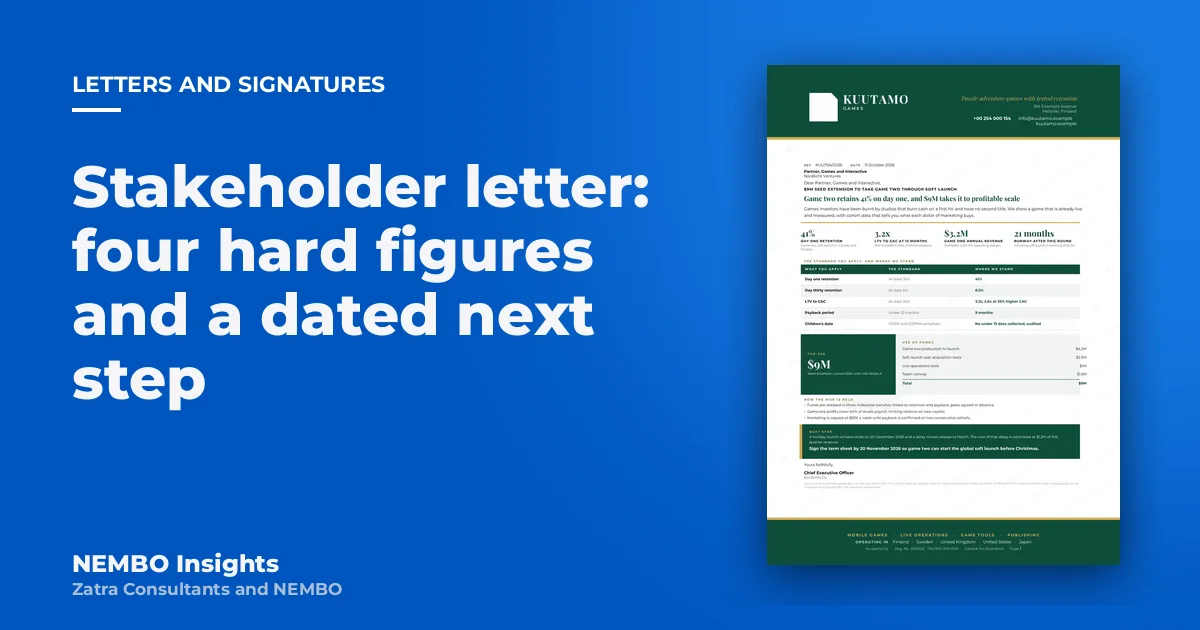
A bank officer, a tender evaluator and an investor each receive several letters a week. The one that is answered states its request in the opening paragraph, carries four figures the reader can test and closes on a date. The one that is filed describes the company.
This note sets out that structure against the published clocks of PPRA, the Bank of Tanzania and CRDB, with a fictional invoice discounting request showing its four figures and its dated next step.
What does a reader act on in a letter?
A reader acts on a letter that makes one request, supports it with figures that can be checked against a published rule, and names the date by which a reply is needed. ISO 24495-1 states four tests for plain language: readers get what they need, find it easily, understand it easily and can use it 2. A letter is built to pass all four.
| Part | What it carries | What the reader does |
|---|---|---|
| Reference and subject | Facility, invoice or tender reference | Routes the letter to the right desk |
| First paragraph | The request and the amount | Decides whether to read on |
| Four figures | Amount, share, age and tenor, each dated | Tests them against the published rule |
| Basis line | Source and date of each figure | Verifies the figure |
| Ask and date | One instruction and one calendar date | Replies or diarises the date |
| Signature block | Name, position and authority | Accepts the letter as the company's |
Where does each figure come from?
Each figure carries a basis line: the ledger date for an amount, the invoice date for an age, and the page and reading date for a lender's condition. A reader who finds the basis line verifies the figure in one step. A reader who finds none treats it as an assertion and writes back to ask.
Which published clocks should the dates follow?
Authorities publish their own dates, and a letter that cites them is easy to answer. Under PPRA's standard tendering document, a tenderer notifies a clarification request through TANePS not later than seven days before the deadline for open competitive methods, and the procuring entity responds within three working days 16. The clause names TANePS as the channel for the request.
The Bank of Tanzania publishes a second clock. A financial institution resolves a complaint within 14 days, or explains the delay no more than 7 days later. The complaint reaches the Bank within two years of the event, and the Bank aims to decide within 45 days of receiving it 3.
Who signs, and with what authority?
A person duly authorised, with the authority shown. PPRA's standard tendering document requires a tender to be signed by a person duly authorised to sign for the tenderer, with authorisation documents indicating each signatory's name and position, and unsigned tenders can be rejected as non-responsive 16. The same discipline suits a letter to a bank or an evaluator: the signature block names the person, the position and the authority.
One invoice dated 5 October 2026, 60-day terms.
TZS 70,000,000, the ceiling on the page as read.
Below the 60-day condition.
Inside the 30 to 90 day range.
Source: CRDB Invoice Discounting Finance, read 17 October 2026; figures computed in the worked example.
Note: illustrative figures for a fictional company on an IFRS basis, excluding VAT. Nothing here is an offer of credit, advice on an application or a guarantee of any lender's decision.
What should a letter to a lender or evaluator leave out?
- A company history placed before the request.
- Adjectives that carry no figure.
- A second request in the same letter.
- An open date in place of a calendar date.
- A figure with no source and no date.
What the NEMBO desk prepares
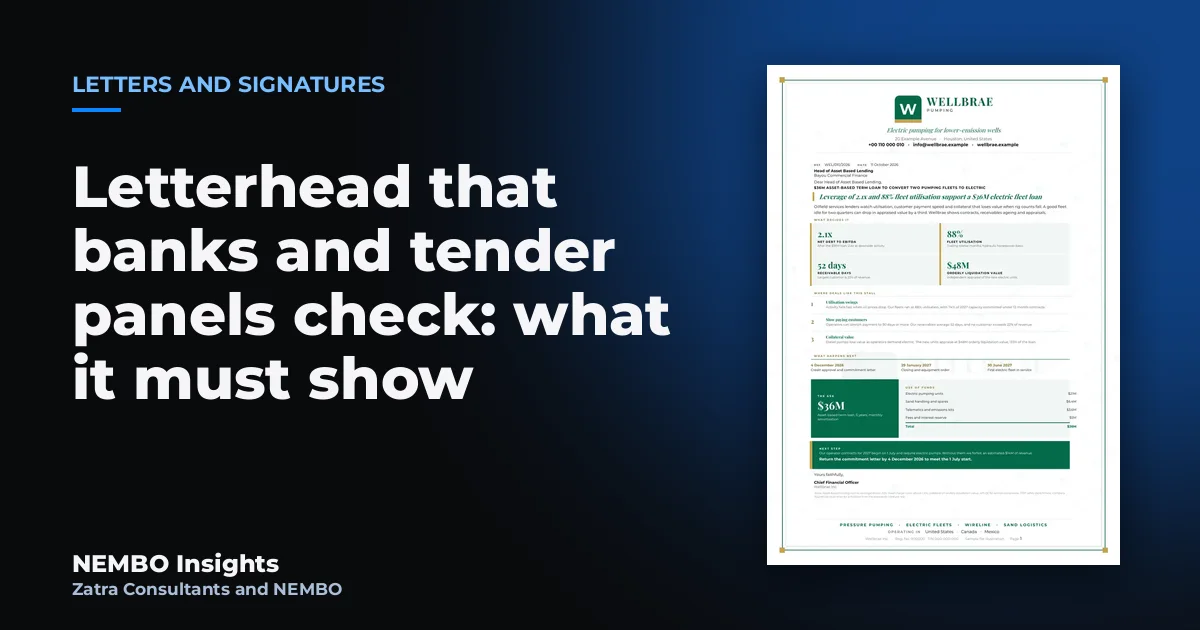
The Client shares the company, the reader and the decision needed. Zatra Consultants Limited checks the figures and their sources, and NEMBO returns the letterhead and the letter together: header and logo lockup, a headline that states the answer, three real pains each with a figure, four numbers that clear the hurdle, the standard set beside the position, the ask and use of funds, a dated next step, and a footer 5. Delivery is in editable Word and print-ready PDF on A4, in hours, and quoted in writing.
The desk prepares the letter. It does not decide, and does not guarantee, the answer of any bank, investor or evaluator.
Letter and letterhead returned together
The desk prepares the letterhead and the letter on the Client's details: header, reference, subject, four hard figures and a dated next step, in editable Word and print-ready PDF on A4.
Share the letter detailsSources and status
Accurate as at 17 October 2026. Every figure below was read at the source named, on the date shown.
- 1Standard Tendering Document for Small WorksPublic Procurement Regulatory Authority (PPRA), February 2022. Accessed 17 October 2026.
- 2The ISO plain language standard, Part 1: governing principlesInternational Plain Language Federation, undated. Accessed 17 October 2026.
- 3Consumer protection and complaint handlingBank of Tanzania, undated. Accessed 17 October 2026.
- 4Invoice Discounting FinanceCRDB Bank, undated. Accessed 17 October 2026.
- 5Letterheads: stakeholder letters on one identityNEMBO, undated. Accessed 17 October 2026.
- 6Standard Tendering Document for Non-Consultancy ServicesPublic Procurement Regulatory Authority (PPRA), February 2022. Accessed 17 October 2026.
Figures to confirm before you act
- The clarification and reply periods of the tendering document in use, with the procuring entity.
- The signing authority and the form of power of attorney a tender requires, with the procuring entity.
- The advance percentage, tenor and invoice-age condition for invoice discounting, with the CRDB branch.
- The current complaint steps and limits for a financial institution, with the Bank of Tanzania.
- The figures quoted in a letter, against the ledger, with the Client's accountant.
This article is general information based on official sources available at the date of publication. It is not legal, tax, valuation or financial advice. Laws and notices change. Verify with the issuing authority or consult Zatra Consultants Limited before acting.
Frequently asked questions
How many figures should a letter carry?
The NEMBO standard is four, each testable against a rule the reader has published and each with a source and a date. A fifth figure dilutes the first four, and a letter with none gives the reader nothing to check.
What date should a letter close on?
One calendar date, set from the reader's own clock. In the worked example the branch confirms eligibility by Friday 30 October 2026 so that drawdown can follow on Monday 2 November. An open date such as next week gives the reader nothing to diarise.
Who should sign a letter to an evaluator?
A person duly authorised to sign for the company. PPRA's tendering document requires authorisation documents indicating each signatory's name and position for a tender, and the signature block of a letter shows the same three things: name, position and authority.
How does a letter relate to the clarification channel in a tender?
The standard tendering document names TANePS as the channel for a clarification request, not later than seven days before the deadline for open competitive methods, with a reply within three working days. A bidder cites the clause in the request and follows the dates the clause sets.
What does plain language require of a business letter?
ISO 24495-1 sets four principles: readers get what they need, can find it easily, can understand it easily and can use it. For a letter, the request sits in the first paragraph, each figure sits where it is found, and the next step is one instruction.
What should the first paragraph say?
The request, the amount and the date a reply is needed. In the worked example that is an advance of TZS 70,000,000 against one invoice of TZS 100,000,000, with eligibility confirmed by Friday 30 October 2026. The reader then decides whether to read on.
Which dates does the Bank of Tanzania publish for complaints?
A financial institution resolves a complaint within 14 days, or explains the delay no later than 7 days after. The complaint reaches the Bank within two years of the event, and the Bank aims to decide within 45 days of receiving it.