On this page
- What does an export buyer look for in a Tanzanian company profile?
- Which registrations and export documents belong in the profile?
- Which certification does a buyer recognise?
- When does the buyer need proof of origin?
- How is the price stated in USD?
- Worked example: capacity and price per tonne
- What the NEMBO desk prepares
- Sources and status
- Frequently asked questions
What should a Tanzanian export company profile include for foreign buyers?
A foreign buyer checks five things: registration and export documents, a recognised certification, available capacity, shipment references and a price in USD on a named Incoterms 2020 rule and port. TBS licences are valid for one year, and EAC trade needs a certificate or origin declaration. The profile states each with number and date.
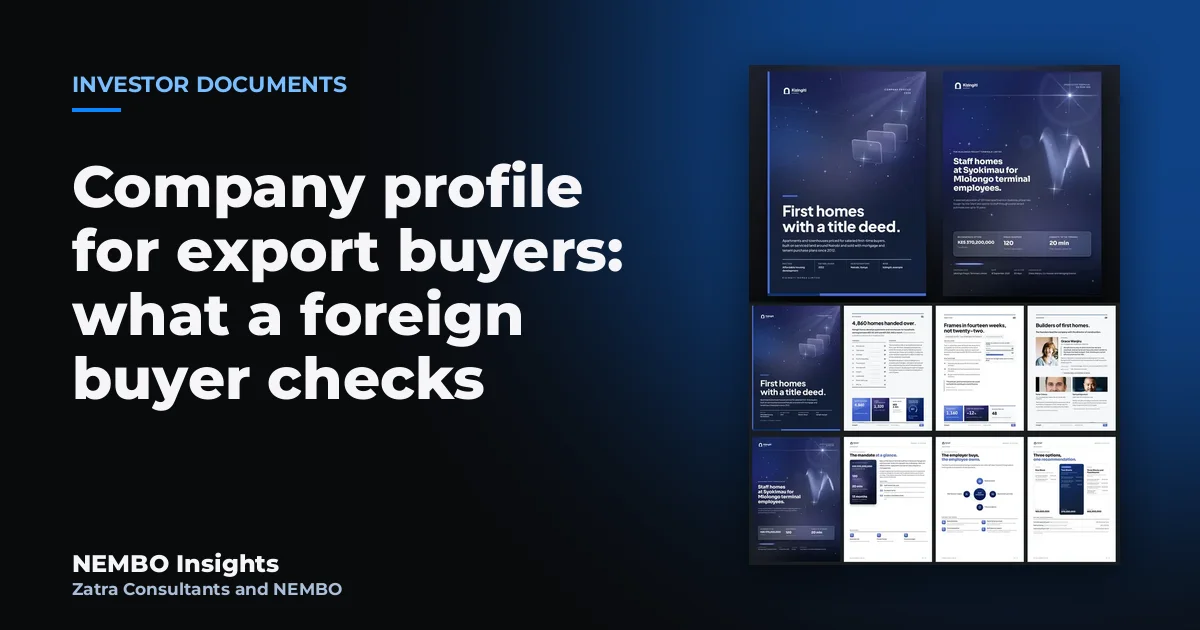
A foreign buyer or procurement team receives a Tanzanian profile with no view of the exporter's premises. The buyer cannot visit the registry, test the product or ask a neighbour. The profile is the whole inspection, and it is read against a short list: what is registered, what is certified, how much can be shipped and what the goods cost delivered to a named place in US dollars.
This note sets out what that list contains, how it differs from a domestic tender profile, which Tanzanian documents answer each line and how a price table in USD is built, as read on 17 October 2026.
What does an export buyer look for in a Tanzanian company profile?
A buyer looks for five things: proof the exporter exists and may export, a certification the buyer's market recognises, installed and available capacity, shipment references, and a price stated on an Incoterms rule in a named currency. A domestic tender profile answers different readers, and the table shows where the two diverge.
| Point | Domestic tender profile | Export buyer profile |
|---|---|---|
| Currency | Tanzanian shillings | US dollars, rule named |
| Price basis | Price schedule in the tender | Incoterms 2020 rule and named place 1 |
| Registration proof | Incorporation, TIN, tax clearance, licence | TIN, exporter documents, sector permits 2 |
| Quality proof | Licences and ISO named by the tender | Standards mark or product certificate 4 |
| Origin | As the tender requires | EAC certificate or origin declaration 5 |
| References | Client recommendation letters | Shipments, buyers by market, dates |
Which registrations and export documents belong in the profile?
The Tanzania Revenue Authority requires an exporter to appoint a licensed clearing and forwarding agent, who uploads the documents to TANCIS. The attachments listed are the invoice, the packing list, the exporter's TIN certificate and an authorization letter, together with permits from the authority responsible for the goods 2. Those permits come from the ministry for agriculture for crops, the ministry for livestock and fisheries, the ministry for minerals, the ministry for natural resources, or the ministry responsible for health, through TMDA 2.
The National Business Portal defines an export permit as an official document needed to export certain types of goods 3. A profile therefore lists the TIN, the agent appointed and each sector permit held, with number and date of issue.
Which certification does a buyer recognise?
The Tanzania Bureau of Standards licenses use of its quality mark or issues a tested product certificate. The applicant applies through the i-SQMT system, TBS inspects the factory and samples the product, the laboratory tests it against the standard, and the licence decision rests on the inspection and laboratory reports. The licence or certificate is valid for one year 4. A profile states the expiry date beside the licence number.
TanTrade's iTIMS portal carries the Made in Tanzania brand mark, launched in July 2025, and a TanTrade account is needed to apply 7. TanTrade's strategic plan charges it with improving market access and with market information for exporters 6.
When does the buyer need proof of origin?
For trade within the East African Community the claim of origin is supported by an EAC certificate of origin, issued by a competent authority that each Partner State designates, or an origin declaration made on the commercial invoice where the goods qualify 5. Goods qualify if wholly produced in a Partner State or sufficiently processed there. The manual's examples allow non-originating materials of up to 70 percent of the ex-works price, which leaves 30 percent value added 5. A profile names the competent authority and the product rule the goods meet.
How is the price stated in USD?
Incoterms 2020 contains 11 rules. Seven apply to any mode of transport (EXW, FCA, CPT, CIP, DAP, DPU, DDP) and four to sea and inland waterway transport (FAS, FOB, CFR, CIF). They allocate costs and risks between buyer and seller, and the ICC states that sales contracts should refer to the 2020 rules 1. A profile states the rule, the named port or place and the currency on every price, since a price without a rule leaves freight and insurance undefined.
Worked example: capacity and price per tonne
| Rule | Per tonne | Per container | Adds |
|---|---|---|---|
| EXW, seller's works | 1,300 | 31,200 | Base price |
| FOB, Dar es Salaam | 1,410 | 33,840 | Haulage 55, clearance 25, handling 30 |
| CFR, named port | 1,530 | 36,720 | Ocean freight 120 |
| CIF, named port | 1,540 | 36,960 | Insurance 10 |
Source: Incoterms 2020 rules, ICC, read 17 October 2026; cost elements are assumptions.
Note: Illustrative only. Fictional prices in USD, prepared on IFRS for SMEs. This is not an offer, a quotation or a guarantee of any buyer's decision.
What the NEMBO desk prepares
Zatra Consultants Limited authors and checks the content and figures. NEMBO designs, produces and delivers the profile. The company profile with a 90-second film is TZS 1,200,000, and a profile built on a wider scope is quoted in writing 8.
- Export company profile with ownership, permits, certificates and expiry dates
- Capacity sheet with installed capacity, utilisation and containers a month
- Price table in USD on a named Incoterms rule and port
- Shipment reference page by market and year, held to documents the Client can show
The desk presents what the Client supplies and substantiates. It does not decide, and it does not guarantee, the decision of any buyer, customs authority or regulator.
Export profile in USD with the evidence behind it
The desk prepares the export company profile, capacity sheet and USD price basis, each line tied to a document.
Open the investor deskSources and status
Accurate as at 17 October 2026. Every figure below was read at the source named, on the date shown.
- 1Incoterms 2020International Chamber of Commerce (ICC), Rules in force 1 January 2020. Accessed 17 October 2026.
- 2Export proceduresTanzania Revenue Authority (TRA), undated. Accessed 17 October 2026.
- 3Export procedureTanzania National Business Portal, undated. Accessed 17 October 2026.
- 4Product certification, standard mark licence and tested product certificateTanzania Bureau of Standards (TBS), undated. Accessed 17 October 2026.
- 5Manual on the Application of the East African Community Customs Union (Rules of Origin) Rules, 2015East African Community Secretariat, Directorate of Customs, September 2015. Accessed 17 October 2026.
- 6Corporate Strategic Plan 2021/2022 to 2025/2026Tanzania Trade Development Authority (TanTrade), September 2022. Accessed 17 October 2026.
- 7Integrated Trade Information Management System (iTIMS), Made in TanzaniaTanzania Trade Development Authority (TanTrade), undated. Accessed 17 October 2026.
- 8Investor documentsNEMBO, undated. Accessed 17 October 2026.
Figures to confirm before you act
- The sector permits required for the goods, with the ministry or authority responsible and the clearing agent.
- The current requirements and validity of a TBS standard mark licence or tested product certificate, with the Tanzania Bureau of Standards.
- The competent authority that issues the EAC certificate of origin and the product rule for the goods, with the Tanzania Revenue Authority and the EAC Secretariat.
- The Incoterms 2020 rule and the named port or place the buyer's contract uses, with the buyer and the freight forwarder.
- The conditions for the Made in Tanzania brand mark, with the Tanzania Trade Development Authority.
This article is general information based on official sources available at the date of publication. It is not legal, tax, valuation or financial advice. Laws and notices change. Verify with the issuing authority or consult Zatra Consultants Limited before acting.
Frequently asked questions
How does an export profile differ from a domestic tender profile?
The currency, the price basis and the proof change. An export profile states prices in USD on an Incoterms 2020 rule and a named port, and adds exporter documents, sector permits, a standards licence and proof of origin. A domestic profile follows the tender checklist in shillings.
Which Incoterms rules apply to sea freight?
Four rules apply to sea and inland waterway transport: FAS, FOB, CFR and CIF. The other seven, EXW, FCA, CPT, CIP, DAP, DPU and DDP, apply to any mode of transport. The profile names the rule that the sales contract uses.
Which documents does TRA list for an export?
The invoice, the packing list, the exporter's TIN certificate and an authorization letter, together with the permits or certificates from the ministry or authority responsible for the goods. A licensed clearing and forwarding agent uploads them to TANCIS.
How long is a TBS standard mark licence valid?
The TBS page states that the licence or tested product certificate is valid for one year only. The holder applies for an extension at the end of each year, and the profile states the expiry date next to the number.
Does every export need a certificate of origin?
Not every export does. For goods traded within the East African Community, origin is claimed with an EAC certificate of origin or, where the goods qualify, an origin declaration on the commercial invoice. The buyer's destination and contract set the requirement.
What does FOB mean in a price table?
Free On Board is one of the four Incoterms 2020 rules for sea and inland waterway transport. The rules allocate costs and risks between seller and buyer, so a profile writes FOB with the named port, such as FOB Dar es Salaam, and lists what the price includes.
Why state capacity as containers a month?
A buyer plans in shipments. Installed capacity, a utilisation rate and tonnes per container give the monthly volume the buyer can order, and the profile shows the working: 600 tonnes at 80 percent is 480 tonnes, or 20 containers of 24 tonnes.