On this page
What is a 13-week cash forecast and how does a lender use it?
A 13-week cash forecast lists receipts and payments by week for one quarter, 91 days, opening at the bank balance and closing each week with cash. It follows cash, not profit. A lender reads the lowest closing week against the facility minimum. The Bank of Tanzania's own liquidity measure uses a 30-day horizon [3].
A manufacturer reports a profit every month, and its lender still asks for the cash position by week. Profit is measured when work is done. Cash moves on the day a customer pays or a loan instalment falls due, and a covenant on minimum cash is tested against the second.
The 13-week cash forecast answers that question. This note sets out its structure, the weekly cadence, how a lender or CFO reads it, and its link to the cash runway test, with one forecast computed to its lowest week.
What is a 13-week cash forecast?
A 13-week cash forecast is a dated schedule of cash receipts and cash payments, one column per week for one quarter, that opens with the bank balance and closes each week with a cash figure. IAS 7 defines cash as cash on hand and demand deposits 1, so the forecast follows cash, not profit. Thirteen weeks is 91 days, one quarter.
How is the forecast structured?
| Line | Source | Control |
|---|---|---|
| Opening cash | Bank statements at the first day of the week | Equals the prior week's closing cash |
| Customer receipts | Receivables ageing and invoices due, entered on the expected collection date | Slip case for the largest customer |
| Supplier payments | Payables ageing and purchase commitments | Dated to the payment run |
| Payroll and statutory payments | Payroll schedule and tax calendar | Entered in the week due |
| Loan instalments | Signed loan schedule | Matches the lender's schedule |
| Capital expenditure | Approved orders | Only committed amounts |
| Closing cash | Opening plus receipts less payments | Compared with the lender's minimum |
IAS 7 allows operating cash flows to be reported by the direct method, which discloses major classes of gross receipts and payments, and the forecast follows that layout 1.
Why weekly, and why 13 weeks?
Weekly columns expose the timing gaps that a monthly view averages away, and short horizons are the most accurate. AFP states that short-term forecasts are always likely to be the most accurate, and recommends a reserve or safety margin to accommodate inaccuracies 2. The Bank of Tanzania's own liquidity measure for banks uses a 30-day horizon and caps recognised inflows at 75 per cent of outflows, and states that a bank cannot rely solely on anticipated inflows 3.
A lender used to that discipline reads receipts with care. A forecast that dates each receipt on its expected collection date, and shows a slip case, answers the same concern.
How does a lender or CFO use it?
- The lowest closing week and its date, the first figure read.
- Headroom: the lowest closing cash less the minimum cash required by the facility.
- The weeks that carry loan instalments and statutory payments.
- The share of receipts due from the largest customer.
- Variance of last week's actual against the forecast, then the forecast rolled forward by one week.
TFRS 1 expects the annual report to discuss cash inflows and outflows in the year, current and prospective liquidity, and covenants in financing contracts 4. A weekly forecast is the working paper behind those paragraphs.
How does it link to the cash runway test?
The cash runway test in the CFO pack divides cash on hand by daily cash costs, and the forecast replaces that average with dated balances 6. The IFRS Foundation's going concern guidance lists the timing of repayment of existing financing facilities among the factors management considers 5, and the forecast shows that timing week by week.
Week beginning 19 October 2026
Week 8, beginning 7 December 2026
Assumed facility term
If the week 8 receipt slips a week, closing cash is 9
Source: worked example computed week by week from the schedule in the callout above.
Note: illustrative figures on a cash basis consistent with IAS 7. The facility minimum is assumed. Nothing here is an offer, a credit decision or a guarantee of any lender's view.
What to do now
- Fix the opening balance Take the bank statement for the first day of week 1.
- Date every receipt Enter each on its expected collection date, from the receivables ageing.
- Enter the fixed payments Place payroll, statutory payments and loan instalments in the week due.
- Find the lowest week Compare it with the facility minimum and compute headroom.
- Run the slip case Move the largest receipt one week later and recompute.
- Roll weekly Replace the week passed with actuals and add week 14.
What the NEMBO desk prepares
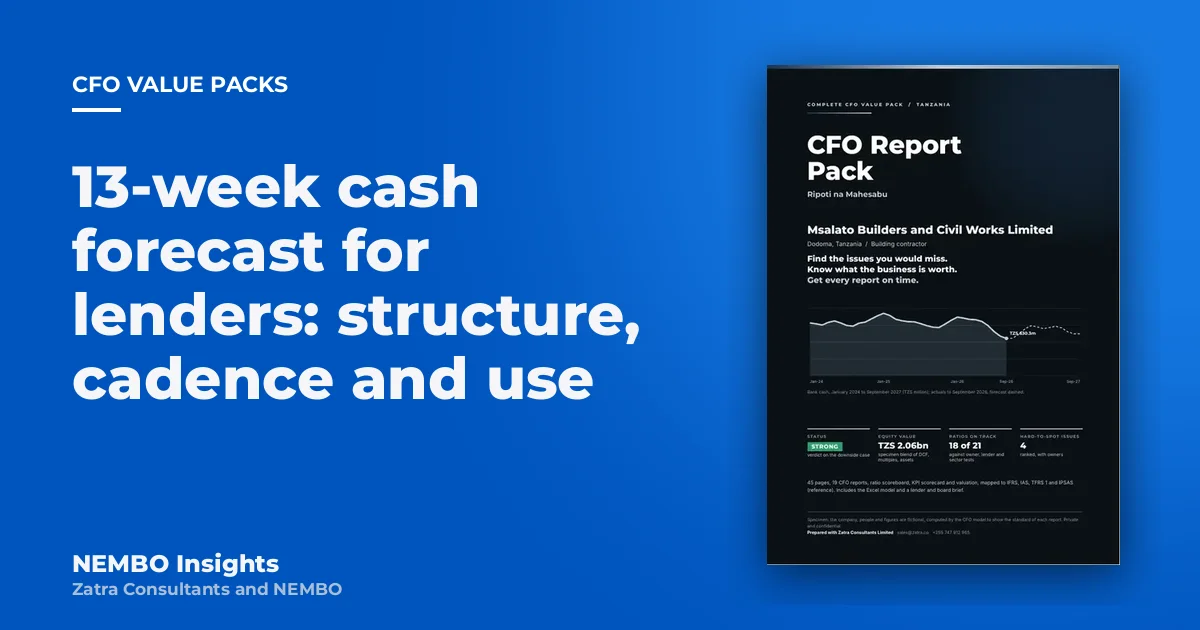
Zatra Consultants Limited authors and checks the figures, and NEMBO designs and delivers. The Client shares the ledger, bank statements and debt schedules. The CFO pack includes a live cash liquidity and runway tracker tested against the owner's own budget, a Lender and Board Brief of about ten pages, and an Excel working file with live formulas 6. Fees are quoted in writing, and the written quote states the date for the scope agreed.
The pack is an illustrative management estimate, not an audit, an assurance report or a valuation, and it decides no lender's view.
A cash forecast a lender can test
The desk prepares the CFO pack with a cash liquidity and runway tracker tested against the owner's own budget, plus an Excel working file.
Open the CFO deskSources and status
Accurate as at 17 October 2026. Every figure below was read at the source named, on the date shown.
- 1IAS 7 Statement of Cash Flows (standard text, 2026 edition)IFRS Foundation, 2026 edition. Accessed 17 October 2026.
- 2What Is Cash Forecasting?Association for Financial Professionals, 26 May 2022. Accessed 17 October 2026.
- 3Guidance Note on Computation of Liquidity Coverage Ratio for Banks and Financial Institutions, 2023Bank of Tanzania, 2023. Accessed 17 October 2026.
- 4Tanzania Financial Reporting Standard No. 1: The Report by Those Charged with GovernanceNational Board of Accountants and Auditors, Approved 22 June 2020. Accessed 17 October 2026.
- 5Going concern, a focus on disclosureIFRS Foundation, Republished May 2025. Accessed 17 October 2026.
- 6CFO Value Pack: financial reports for Tanzanian businessesNEMBO, undated. Accessed 17 October 2026.
Figures to confirm before you act
- The minimum cash and any other covenant in the facility, with the lender.
- The loan instalment dates and amounts, from the signed loan agreement, with the lender.
- The expected collection date of the largest receipts, with the customer.
- The statutory payment dates for the period, with the Tanzania Revenue Authority, or the Zanzibar Revenue Authority for a Zanzibar entity.
- The reporting basis of the entity, with its accountant.
This article is general information based on official sources available at the date of publication. It is not legal, tax, valuation or financial advice. Laws and notices change. Verify with the issuing authority or consult Zatra Consultants Limited before acting.
Frequently asked questions
What is a 13-week cash forecast?
It is a dated schedule of cash receipts and payments, one column per week for 13 weeks, starting at the bank balance and ending each week with closing cash. It follows cash, not profit, and it is compared with the lender's minimum cash.
Why 13 weeks and not 12 months?
Thirteen weeks is one quarter, a horizon in which receipts and payments can be dated with some confidence. Short-term forecasts are the most accurate. A 12-month model supports the annual plan, and the 13-week forecast supports the lender conversation now.
How often is the forecast updated?
Weekly. The week that has passed is replaced with actuals, the variance against the forecast is noted, and a new week 14 is added so the horizon stays at 13 weeks. The lowest week and the headroom are recomputed each time.
What is covenant headroom?
Headroom is the lowest closing cash in the forecast less the minimum cash the facility requires. In the worked example it is 64 less 60, which is 4. A positive figure means the covenant holds in the forecast. The lender's own definition governs.
How does the forecast relate to the cash runway test?
Runway divides cash by daily cash costs and gives an average. The forecast gives the dated balance for each week, so the lowest week shows when the business is closest to the minimum. In the example, week 8 holds 4.5 days of runway.
Does the forecast show profit?
No. It shows cash. A sale appears in the week the customer pays and a cost in the week the supplier is paid. The profit forecast and the cash forecast agree over time, and the lender reads the cash forecast for timing.
Does the forecast guarantee a lender's decision?
No. It is a planning document prepared from the Client's records. The lender applies its own credit policy, covenant definitions and judgement, and the NEMBO desk does not decide or guarantee any lender's decision.