On this page
- What does a CFO verdict actually test?
- How is cash runway measured, and what does 30 days mean?
- What is debt service cover and what does 1.60 mean?
- Why is net margin tested in the downside case?
- Which reporting framework labels the pack?
- Why does the downside case matter more than the base case?
- How is the STRONG, WATCH or ACT NOW verdict set?
- Is a CFO verdict a valuation, an audit or a credit decision?
- What do the three tests show for one specimen business?
- How Zatra Consultants and NEMBO handle this
- What to do now
- Sources and status
- Frequently asked questions
What three tests decide a CFO verdict of STRONG, WATCH or ACT NOW?
The CFO Value Pack tests cash runway, debt service cover and net margin in the downside case, with the same written tests for every pack. Runway is cash over daily cash costs, cover is operating cash flow over scheduled loan payments, and margin is net profit over revenue. The result is an illustrative model estimate, not a valuation, audit or credit decision.
A bakery owner in Dar es Salaam can report a profit and still miss a loan instalment. Profit is an accounting result for a period. An instalment is a cash payment on a date. The two can sit apart for months, and a lender reads the second more closely than the first.
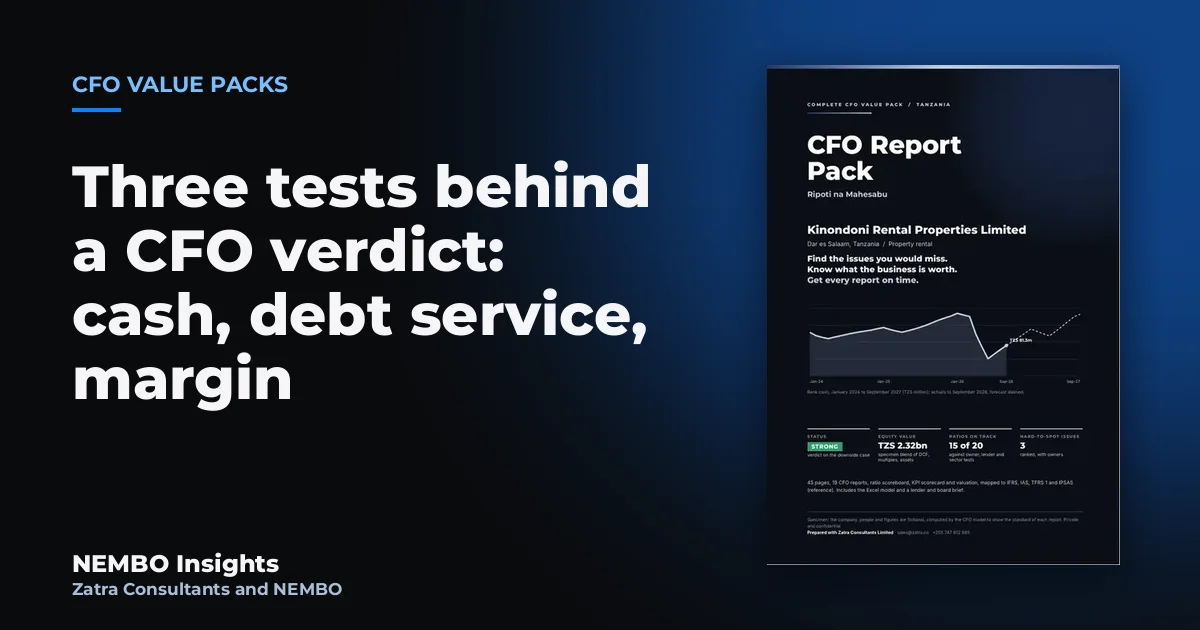
A CFO verdict starts from that gap. The CFO Value Pack ends in one of three words, STRONG, WATCH or ACT NOW, and the word rests on three written tests, each run in the downside case: cash runway, debt service cover and net margin. A business that holds up only in a good year has not passed anything. This note sets out the three tests, the arithmetic behind each, the reporting framework that labels the pack, and what the verdict is not.
What does a CFO verdict actually test?
It tests whether the business can meet its obligations on the dates they fall due, and whether it still earns a profit when sales fall short. Owners usually know sales. The verdict needs three other numbers 7.
| Test | Formula | Base case | Downside case |
|---|---|---|---|
| Cash runway | Cash on hand divided by daily cash costs | 18,000,000 over 600,000 is 30 days | Read against dated payments, see below |
| Debt service cover | Operating cash flow divided by scheduled loan payments | 48,000,000 over 30,000,000 is 1.60 | 36,000,000 over 30,000,000 is 1.20 |
| Net margin | Net profit divided by revenue | 27,000,000 over 900,000,000 is 3.00 per cent | 15,000,000 over 860,000,000 is 1.74 per cent |
The same three tests apply to every pack, so the verdict for one business can be compared with the verdict for another. This note explains the tests. It does not restate the cut-offs between STRONG, WATCH and ACT NOW.
How is cash runway measured, and what does 30 days mean?
Runway is cash on hand divided by daily cash costs. A business holding TZS 18 million and spending TZS 600,000 a day in cash costs has 18,000,000 over 600,000, which is 30 days. The figure is only useful beside the date of the next large payment out and the date of the next large payment in.
Cash itself comes from the statement of cash flows. IAS 7 sets out how an entity presents how its cash and cash equivalents changed in a period, and it allows operating cash flows to be reported by the direct method, which shows major classes of gross receipts and payments, or by the indirect method, which adjusts profit or loss for non-cash items, accruals and deferrals, and items linked to investing or financing 1. Either method gives the operating cash figure that the next test uses.
| Day | Event | Cash balance |
|---|---|---|
| 0 | Opening cash | 18,000,000 |
| 21 | Before supplier payment (21 days at 600,000 is 12,600,000) | 5,400,000 |
| 21 | After a supplier payment of 12,000,000 | minus 6,600,000 |
| 25 | Before a customer receipt (4 more days at 600,000 is 2,400,000) | minus 9,000,000 |
| 25 | After a customer receipt of 15,000,000 | 6,000,000 |
| 30 | After 5 more days at 600,000 (3,000,000) | 3,000,000 |
The business shows 30 days of runway and still runs short between day 21 and day 25. A headline runway figure therefore never replaces the dated schedule.
What is debt service cover and what does 1.60 mean?
Debt service cover is operating cash flow divided by scheduled loan payments. With TZS 48 million of operating cash flow and TZS 30 million of scheduled payments, cover is 48,000,000 over 30,000,000, which is 1.60. The business has TZS 1.60 of operating cash for each TZS 1.00 due to lenders.
In the downside case, operating cash falls by a quarter, to 48,000,000 times 0.75, which is TZS 36 million. Cover falls to 36,000,000 over 30,000,000, which is 1.20. A ratio under 1.00 means operating cash does not meet the payments. Lenders set their own minimum, and the figures above are an illustration, not a benchmark. The ratio is a lender's measure, and each lender defines it.
The wider lending picture gives the ratio context. The Bank of Tanzania reported that the banking sector's non-performing loan ratio fell to 3.3 per cent in December 2024 from 4.3 per cent in December 2023, and that 83.7 per cent of non-financial corporate borrowers were in good condition, against 80.1 per cent in 2023 4. Those are sector figures for the banks' book as a whole. They set no minimum for any single borrower.
Why is net margin tested in the downside case?
Net margin is net profit divided by revenue. Tested in the downside case, it shows how much of a revenue shortfall the business can absorb before it stops making money. The measure is simple. The insight comes from how much sales can fall before profit reaches zero.
The shortfall the business can absorb equals net profit divided by the share of each shilling of sales that is left after variable costs. If that share is 30 per cent and net profit is TZS 27 million, the business absorbs 27,000,000 over 0.30, which is TZS 90 million of lost sales, or 10.0 per cent of TZS 900 million of revenue. A fall larger than that produces a loss.
Which reporting framework labels the pack?
A financial statement or model names its basis. The National Board of Accountants and Auditors sets the framework by the size and nature of the entity in Technical Pronouncement No. 1 of 2018, which applies to periods beginning on or after 1 April 2019 3.
| Framework | Applies to |
|---|---|
| Full IFRS Accounting Standards | Public interest entities, including entities with traded debt or equity, banks and insurers; commercial entities with total gross capital of not less than TZS 50 billion in strategic sectors; public commercial entities |
| IPSAS | Public sector entities that serve the public benefit and are funded mainly through taxes, transfers and fees; political parties |
| IFRS for SMEs | Commercial entities that are not public interest entities, with annual turnover of TZS 800 million or more and total assets of TZS 400 million or more |
| Financial Reporting Standard for Micro Entities (FRSME) | Entities that are not public interest entities and meet at least two of three tests: turnover not more than TZS 800 million, total assets not more than TZS 400 million, average employees not more than 10 |
The third edition of the IFRS for SMEs was issued in February 2025 and is effective for annual periods beginning on or after 1 January 2027, with earlier application permitted 2. Which edition applies to a given period is confirmed with the entity's accountant. TFRS 1 is the NBAA standard on the Report by Those Charged with Governance, effective for periods beginning on or after 1 January 2021. It applies to all entities except those applying the FRSME, which may opt to prepare the report 5.
These pronouncements are Mainland publications. Zanzibar has its own registry and revenue authority, and an entity registered there needs separate confirmation of the framework and the filing position.
Why does the downside case matter more than the base case?
Because the base case describes the year the owner hopes for, and the lender plans for the year that goes wrong. Lenders run downside tests of their own. The Bank of Tanzania reported that its stress tests found banks adequately capitalised to withstand both proportionate and sectoral increases in non-performing loans 4. A downside case in a borrower's pack follows the same logic at the level of one business.
- A base-case ratio shows capacity in a normal year.
- A downside ratio shows whether the loan survives a bad quarter.
- A dated cash schedule shows whether the timing of payments breaks a business that the ratios clear.
A pack that reports only the base case invites the question the downside answers. A pack that reports both answers it before the lender asks.
How is the STRONG, WATCH or ACT NOW verdict set?
The value pack applies written tests on cash, debt service cover and net margin in the downside case, the same tests to every pack, and states the result as STRONG, WATCH or ACT NOW 7. Because the tests are written and identical, no single case is tuned by hand.
The pack carries a ratios page and an action list beside the verdict 7. It gives an illustrative model estimate. It is not an audit, an assurance report or a valuation.
Is a CFO verdict a valuation, an audit or a credit decision?
It is none of the three. A valuation in Mainland Tanzania sits under the Valuation and Valuers Registration Act, 2016, Act No. 7 of 2016. The text read states that it applies in Mainland Tanzania and that a person or firm may not undertake valuation activity without a certificate from the Valuers Registration Board 6. The value pack is an illustrative model estimate, not a valuation under that Act.
It is not an audit or an assurance report, which carry their own standards and signatures. It is not a credit decision either. Banks, panels and officers decide for themselves, and the pack does not decide or guarantee any of those decisions.
What do the three tests show for one specimen business?
The example shows why the tests are read together. Each test clears in isolation, and the dated schedule shows the weakness. The verdict word is only as good as the schedule behind it.
How Zatra Consultants and NEMBO handle this
Zatra Consultants Limited authors and checks the content and the figures. NEMBO designs, produces and delivers. Short documents are targeted at under 30 minutes from complete details, standard documents take hours, and research documents are dated in the written quote. The pack names the reporting framework by category on its cover 78.
No outcome is promised. The desk does not decide or guarantee any bank's, panel's, officer's or authority's decision, and the entity's own accountant confirms the framework tier that applies to it.
What to do now
- Fix the basis Confirm the framework tier with the accountant, using turnover, total assets, average employees and public interest status.
- List the loan schedule Write every scheduled payment for the next 12 months with its date, from the loan agreements.
- Build the dated cash schedule Place known payments out and receipts in against the daily cash cost, and find the lowest balance.
- Set the downside Choose one shortfall in sales, apply it to operating cash and to profit, and recompute cover and margin.
- Read the result against the lender Ask the lender for its own minimum cover, since lenders set their own, and compare.
Financial reports and CFO packs
Verdict and conditions on page one, ratios and actions behind it. Set by scope.
Share the details for financial reports and cfo packsSources and status
Accurate as at 16 October 2026. Every figure below was read at the source named, on the date shown.
- 1IAS 7 Statement of Cash FlowsIFRS Foundation, undated. Accessed 16 October 2026.
- 2Overview of the third edition of the IFRS for SMEs Accounting StandardIFRS Foundation, 2025. Accessed 16 October 2026.
- 3Technical Pronouncement No. 1 of 2018: Scope of the Applicability of IFRSs, IPSASs, IFRS for SMEs and FRSME in TanzaniaNational Board of Accountants and Auditors, Approved 26 September 2018. Accessed 16 October 2026.
- 4Tanzania Financial Stability Report, December 2024Bank of Tanzania, December 2024 edition. Accessed 16 October 2026.
- 5Tanzania Financial Reporting Standard No. 1: The Report by Those Charged with GovernanceNational Board of Accountants and Auditors, Approved 22 June 2020. Accessed 16 October 2026.
- 6Valuation and Valuers Registration Act, 2016 (Act No. 7 of 2016)Government of Tanzania, text hosted by Policy Vault Africa, Assented 23 September 2016. Accessed 16 October 2026.
- 7CFO Value Pack: financial reports for Tanzanian businessesNEMBO, undated. Accessed 16 October 2026.
- 8Free checklists: the reporting framework decision sheetNEMBO, undated. Accessed 16 October 2026.
Figures to confirm before you act
- The reporting framework tier for the entity, confirmed with its accountant against Technical Pronouncement No. 1 of 2018 and any later pronouncement the National Board of Accountants and Auditors has issued.
- The minimum debt service cover that the lender applies, which each lender sets and which this note does not give.
- The edition of the IFRS for SMEs in force for the reporting period, since the third edition is effective for annual periods beginning on or after 1 January 2027.
- The dates and amounts of scheduled loan payments, taken from the signed loan agreements.
- For an entity registered in Zanzibar, the framework and filing position, confirmed with Zanzibar's own registry and revenue authority.
This article is general information based on official sources available at the date of publication. It is not legal, tax, valuation or financial advice. Laws and notices change. Verify with the issuing authority or consult Zatra Consultants Limited before acting.
Frequently asked questions
Why test the downside case instead of the forecast?
A forecast describes the year the owner expects. A lender prices the risk that the year goes wrong. A downside case answers the lender's question in advance, so the pack shows how far operating cash and profit can fall before the loan payments are missed.
Can a business with a high runway still fail the verdict?
Yes. Runway is an average. If a large supplier payment falls before a large customer receipt, the balance can go below zero while the headline runway reads 30 days. A dated cash schedule shows that gap.
What does a cover ratio under 1.00 mean?
Operating cash is below the scheduled loan payments, so the business must find the difference from reserves, new borrowing or asset sales. The ratio says nothing about profit, because depreciation and working capital move cash and profit apart.
Does a micro entity use these tests?
The tests are the same. The label differs. An entity meeting two of the three micro-entity tests applies the FRSME, and the pack names that framework on its cover instead of IFRS for SMEs.
Is the verdict a valuation of the business?
No. A valuation in Mainland Tanzania falls under the Valuation and Valuers Registration Act, 2016, which requires registration with the Valuers Registration Board. The pack is an illustrative model estimate.
Who should read the pack?
The pack is written for owners, accountants, boards and lenders [7]. An owner sees where cash leaks, an accountant works from one structure across many clients, and a lender sees the downside case beside the base case.
Does the pack replace the entity's accountant?
No. The entity's own accountant confirms the framework tier, the figures and the filing position. The pack organises the numbers and tests them. It does not audit them or give assurance over them.