On this page
- What does the CRDB SME Bidii page say?
- Does a published eligibility list mean the file can stay thin?
- What does the TZS 50 million floor change?
- Which evidence does the cash flow point need?
- Worked example: debt service cover on a TZS 100 million loan
- What does the credit bureau check add?
- Which documents should a file hold in any case?
- Which reporting framework should the financial statements follow?
- Does the same file apply in Zanzibar?
- Who handles a complaint about the lender's service?
- What to do now
- How Zatra Consultants and NEMBO handle this
- Sources and status
- Frequently asked questions
What does CRDB require for an SME Bidii loan and what should the file contain?
As read on 14 October 2026, CRDB publishes a TZS 50 million to TZS 5 billion band over 6 to 24 months and six eligibility points: age, three years' experience, steady cash flow, a premise, a valid licence and a Biashara account. No document checklist is published. The branch's own list governs, and a plan evidences the cash flow, experience and approvals.
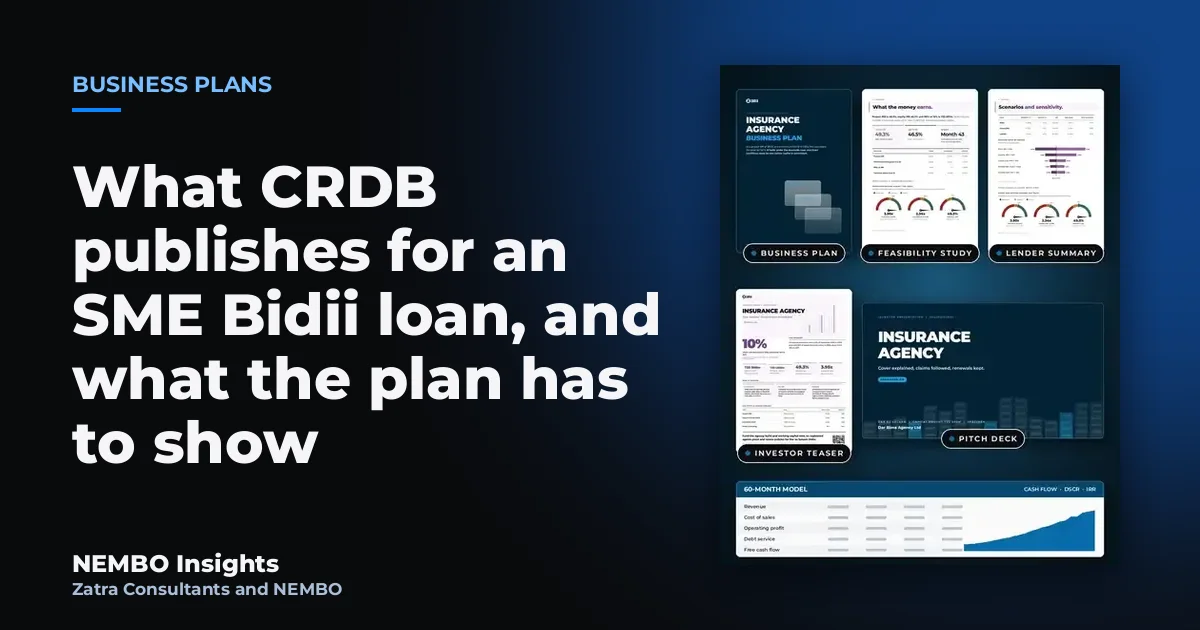
CRDB Bank publishes the loan band for SME Bidii, six eligibility points and no document checklist. A founder reading that page cannot tell whether a business plan is wanted, which statements are needed or whether collateral enters the decision. Most founders respond by preparing everything or nothing, and both costs time.
The page is the clearest published statement a Tanzanian bank offers an SME borrower, which is why it is the one to read first. This note sets out the terms as read on 14 October 2026, the evidence a file can carry for each point, the arithmetic behind debt service cover and the order in which a file is best assembled. It records what the page leaves unsaid as plainly as what it states.
What does the CRDB SME Bidii page say?
As read on 14 October 2026, the page states a loan band of TZS 50,000,000 to TZS 5,000,000,000 over 6 to 24 months 8. It lists six eligibility points. The page was not available for a second reading on 16 October 2026, so every figure in this section stays dated to the earlier reading, and the branch confirms current terms before any application.
| Published point | Evidence a file can carry |
|---|---|
| Applicant aged 18 or over | Identity document of each owner or director |
| Three years' minimum experience managing the same or a similar business | Management page with dated roles, supplier and customer references |
| Steady cash flow | 60-month model, downside case, debt service cover, bank statements |
| A business premise, owned or rented | Title deed or lease agreement |
| A valid business licence or permit | Copy of the licence or permit, within its validity date |
| A CRDB Biashara account, opened or maintained | Statements of the Biashara account |
The page lists no document checklist beyond the licence. It does not mention a business plan, financial statements, bank statements or collateral. It also publishes no interest rate and no fee, and neither figure appears in this note.
Does a published eligibility list mean the file can stay thin?
No. Eligibility says who may apply. A checklist says what the branch needs in order to decide, and only the first is published. The branch's own list governs, and the credit decision rests with CRDB. The desk cannot state what a credit officer will ask for, and no document guarantees an approval.
A plan is not named as a requirement, and a plan on its own evidences none of the six points. What a plan does is gather the evidence for three of them in one sequence: the cash flow as a model with a downside case, the experience as a dated management page, and the licence and premise as an approvals page. A file that answers all six points with a document leaves fewer reasons for a request to come back.
What does the TZS 50 million floor change?
The band starts at TZS 50 million and ends at TZS 5 billion, so the ceiling is 100 times the floor (5,000 divided by 50). A borrower who needs TZS 15 million sits below the published band and asks the branch which product applies, because the page as read names none.
The tenor limits also set the minimum repayment. A principal of TZS 50,000,000 over 24 months repays TZS 2,083,333 a month before interest (50,000,000 divided by 24). Over 6 months the same principal repays TZS 8,333,333 a month before interest. A borrower choosing the tenor is choosing a monthly cash demand, and the model should show which of the two the business carries.
For a smaller or earlier request, the plan format includes a lender summary of fourteen pages, sent without the full plan. It carries the same cash flow, experience and approvals evidence in a shorter file.
Which evidence does the cash flow point need?
Steady cash flow is the only point on the list that a borrower proves with analysis and not with a certificate. Three items carry it. The first is a 60-month model whose inputs can be changed and whose outputs follow. The second is a downside case, because a plan that works only in the base case is a forecast and not evidence. The third is debt service cover.
Debt service cover is operating cash flow divided by scheduled loan payments over the same period. A ratio below 1.00 means operating cash does not meet the payments. Lenders set their own minimum, and the SME Bidii page, as read, publishes none. The Biashara account rule points to the other half of the proof: bank statements showing that the income in the model reaches the account.
Worked example: debt service cover on a TZS 100 million loan
The example shows why the downside case belongs in the file. A base-case cover of 1.25 reads comfortably. The same business at 1.00 in the downside has no margin, and a plan that discloses this has told the credit officer what the officer would otherwise have to calculate.
What does the credit bureau check add?
A lender can consult a credit reference bureau on a new application, and the Bank of Tanzania (Credit Reference Bureau) Regulations, 2012 (GN No. 416) set the conditions. Access to a bureau database requires the borrower's written consent (Regulation 24(1)). Credit investigation on a new application is a permissible purpose (Regulation 23(5)(a)) 1.
The same regulations give an individual the right to request a credit report free of charge once every twelve months (Regulation 28(1)(c)) and to challenge inaccurate information (Regulation 29). Credit information is retained for six years after final repayment, bankruptcy, assignment or write-off (Regulation 36) 1. A borrower who obtains the report before applying can correct an error before a credit officer sees it. The regulations as read do not oblige a lender to consult a bureau; they set conditions when it does. The current text, with any amendment, is confirmed with the Bank of Tanzania.
Which documents should a file hold in any case?
None of the items below is a CRDB rule as published. They are what a loan file commonly needs, and the branch confirms its own list.
| Document | Issued by | Supports |
|---|---|---|
| Certificate of incorporation or business name registration | Registry (Mainland, or Zanzibar's own registry) | Existence and ownership |
| Tax registration certificate | Tanzania Revenue Authority, or Zanzibar Revenue Authority for Zanzibar | Tax standing |
| Business licence or permit named on the page | Licensing authority for the activity | Published licence point |
| Title deed or lease for the premise | Owner, lessor or lands registry | Published premise point |
| Statements of the Biashara account | CRDB Bank | Published account point and cash flow |
| Financial statements under the applicable framework | Entity, with auditor where required | Cash flow and size of business |
| 60-month model with downside case and cover | Entity, with adviser | Published cash flow point |
| Management page with dated roles | Entity | Published experience point |
| Credit report | Licensed credit reference bureau | Pre-application check |
Which reporting framework should the financial statements follow?
The framework follows the size and nature of the entity and is set by the National Board of Accountants and Auditors. Technical Pronouncement No. 1 of 2018, effective for periods beginning on or after 1 April 2019, assigns IFRS for SMEs to commercial entities that are not public interest entities and have annual turnover of TZS 800 million or more and total assets of TZS 400 million or more. It assigns the Financial Reporting Standard for Micro Entities where at least two of three tests are met: turnover of not more than TZS 800 million, total assets of not more than TZS 400 million, and an average of not more than ten employees 4.
Technical Pronouncement No. 1 of 2024 adopts IFRS S1 and S2 on sustainability reporting. It makes them mandatory for public interest entities from 1 January 2025 and encourages other entities to comply 5. A typical SME borrower is not a public interest entity. A separate note in this series, Which financial reporting framework applies, works through the tiers.
Does the same file apply in Zanzibar?
Tanzania Mainland is the default for this note. The CRDB page, as read, does not address Zanzibar, and whether a branch accepts Zanzibar documents is confirmed with that branch. Zanzibar has its own registry and its own revenue authority, so a Zanzibar business holds Zanzibar documents.
The Zanzibar Revenue Authority issues a ZRA Registration Number, also called a Zanzibar Taxpayer Number. Under the Tax Administration and Procedure Act No. 7 of 2009, section 5(2), a person applies to the Commissioner within fifteen days from the date of commencing business, and a trader with yearly sales above TZS 5,000,000 must register 6. For a company the ZRA page lists an application letter, memorandum and articles of association, a stamped title deed or lease, a TIN copy, the certificate of incorporation or compliance, a business licence and the identity documents of at least two directors 6.
Who handles a complaint about the lender's service?
A complaint about service is a separate matter from the decision on credit, which rests with the lender. The Bank of Tanzania publishes the complaint route under its Financial Consumer Protection Regulations, 2019 (GN 884) 23. The steps and limits below are those stated on the Bank's page.
| Step | Limit stated by the Bank |
|---|---|
| Complaint to the financial institution | The institution resolves it within 14 days, or explains the delay no later than 7 days after the deadline |
| Complaint to the Bank of Tanzania | Within 14 days of a disagreement with the outcome or of no response within 14 days |
| Time from the event | The complaint reaches the Bank within two years of the event |
| Decision by the Bank | The Bank aims to decide within 45 days of receiving the complaint |
Complaints may be filed in English or Kiswahili 2.
What to do now
- Read the page again Open the CRDB SME Bidii page on the day of the application and compare the band, tenor and eligibility points with those in this note.
- Ask the branch for its list Request the document list in writing, and ask whether a business plan, bank statements or collateral are expected.
- Obtain the credit report Request the free annual report from a licensed bureau and correct any error before the application.
- Fix the framework Confirm the reporting tier with the entity's accountant, and prepare statements under that framework.
- Build the model Prepare the 60-month model with the downside case and show debt service cover in both.
- Assemble the evidence in the order of the six points Place one document behind each published point, and use the one-page checklist 7 to tick them off.
How Zatra Consultants and NEMBO handle this
Zatra Consultants Limited authors and checks the content and figures of the loan file. NEMBO designs, produces and delivers it. Short documents, such as the lender summary or the checklist, are targeted at under 30 minutes from complete details. Standard documents, such as the full file layout, take hours. Research documents are dated in the written quote.
The desk prepares the file. It does not decide, and it does not guarantee, the decision of CRDB, a credit committee, a credit officer or any other lender. Nothing in this note is an offer of credit or advice on a particular application.
Business plans and feasibility studies
Verdict on the first page: GO, REVISE or STOP. Set by scope.
Share the details for business plans and feasibility studiesSources and status
Accurate as at 16 October 2026. Every figure below was read at the source named, on the date shown.
- 1The Bank of Tanzania (Credit Reference Bureau) Regulations, 2012, GN No. 416Bank of Tanzania, 28 December 2012. Accessed 16 October 2026.
- 2Consumer protection and complaint handlingBank of Tanzania, undated. Accessed 16 October 2026.
- 3Bank of Tanzania (Financial Consumer Protection) Regulations, 2019, GN 884TanzLII, 22 November 2019. Accessed 16 October 2026.
- 4Technical Pronouncement No. 1 of 2018National Board of Accountants and Auditors, 26 September 2018. Accessed 16 October 2026.
- 5Technical Pronouncement No. 1 of 2024, Adoption and Implementation of Sustainability Reporting Standards in TanzaniaNational Board of Accountants and Auditors, 1 July 2024. Accessed 16 October 2026.
- 6Registration of taxpayers, ZRA Registration NumberZanzibar Revenue Authority, undated. Accessed 16 October 2026.
- 7SME loan file checklist, one pageNEMBO, undated. Accessed 16 October 2026.
- 8SME Bidii business loanCRDB Bank, undated. Accessed 14 October 2026.
Figures to confirm before you act
- The current SME Bidii band, tenor and six eligibility points, with the CRDB branch. CRDB's Swahili SME Bidii page prints a ceiling of TZS 3,000,000,000 and a tenor of 6 to 60 months, which differ from the English page.
- Whether the branch expects a business plan, financial statements, bank statements or collateral, with the CRDB branch.
- The interest rate and fees, which the page as read does not publish, with the CRDB branch.
- The current text of the Credit Reference Bureau Regulations, 2012 and any amendment, with the Bank of Tanzania.
- The applicable reporting framework for the entity, with the National Board of Accountants and Auditors or the entity's accountant.
- The registration and tax documents of a Zanzibar business, with the Zanzibar Revenue Authority and the Zanzibar registry.
This article is general information based on official sources available at the date of publication. It is not legal, tax, valuation or financial advice. Laws and notices change. Verify with the issuing authority or consult Zatra Consultants Limited before acting.
Frequently asked questions
Does CRDB require a business plan for SME Bidii?
The page, as read on 14 October 2026, does not name a business plan among its requirements and lists no document checklist beyond the licence. That is a statement about the page, not about the branch. The branch's written list governs, and a borrower asks for it before preparing the file.
Why does the tenor matter to a file?
Tenor sets the monthly cash demand. On a principal of TZS 50 million, 24 months means about TZS 2.08 million a month before interest and 6 months about TZS 8.33 million. The model should show which demand the business carries and whether the downside case still meets it.
What is a good debt service cover?
No figure is published on the SME Bidii page as read. Each lender sets its own minimum. The ratio is operating cash flow divided by scheduled payments, and a value below 1.00 means operating cash does not meet them. The branch states the minimum that applies to the application.
Can a borrower see the credit report a lender uses?
Under the Credit Reference Bureau Regulations, 2012, an individual may request a credit report free of charge once every twelve months and may challenge inaccurate information. The borrower should request it before applying and ask the bureau to correct any error.
Is a different file needed for a loan below TZS 50 million?
The SME Bidii band as read starts at TZS 50 million, so a smaller request is raised with the branch, which states the product that applies. The shorter lender summary can accompany such a request, but the branch decides which documents it accepts.
What if the entity is registered in Zanzibar?
The documents come from Zanzibar bodies: its own registry and the Zanzibar Revenue Authority, which issues a ZRA Registration Number. Whether a CRDB branch accepts them, and on what terms, is confirmed with that branch before the application is lodged.
How long does the desk take to prepare a file?
Short documents are targeted at under 30 minutes from complete details, standard documents in hours, and research documents on the date stated in the written quote. The time to a lender's decision is the lender's and is not estimated.