On this page
What is the difference between a feasibility study and a business plan?
A feasibility study decides whether a project proceeds, using net present value, internal rate of return and payback against thresholds fixed in advance. A business plan then sets out how the approved project is financed and run, and is the document lenders and TISEZA receive. In the worked example an IRR of 17.5 percent clears a 16 percent hurdle.
A founder seeking TZS 1.2 billion is asked for a business plan by one reader, a feasibility study by another and both by a third, usually without an explanation. The two documents answer different questions for different readers at different moments. This note separates them, records what the published lender and authority pages actually ask for, and works a go or no-go test in full.
What does a feasibility study decide?
A feasibility study decides whether a project should proceed. The UNIDO manual calls it a means to arrive at an investment decision, placed in the pre-investment phase after the opportunity and pre-feasibility studies and before the final evaluation 1. Its financial evaluation reports net present value, internal rate of return and payback period, with sensitivity analysis 1.
The result is a verdict against thresholds fixed before the cash flows are read: net present value above zero at a stated discount rate, an internal rate of return above that rate, and payback inside the loan tenor. A verdict to stop is a valid and useful result.
What does a business plan execute?
A business plan executes a project already judged viable. It sets out the market served, the operation, the staffing, the approvals, the funding and the 60-month cash flow in the order a lender reads, and it is the document that accompanies an application. TISEZA, for example, lists a project business plan and evidence of sufficient finance among the eight documents for a certificate of incentives 2.
How do the two documents differ?
| Item | Feasibility study | Business plan |
|---|---|---|
| Question answered | Should the project proceed? | How will the approved project be financed and run? |
| Typical reader | Investment committee, development lender, board | Credit officer, TISEZA, private investor |
| Moment | Before capital is committed | With the application, then through operation |
| Core tests | NPV, IRR, payback, sensitivity | Cash flow, debt service cover, approvals, staffing |
| Result | Go, revise or stop | A funded and scheduled programme |
Which document does a Tanzanian lender or authority ask for?
The bank pages read name cash flow evidence, and no page read names a feasibility study. The NMB SME Loans page, for TZS 50,000,000 to TZS 1,500,000,000, lists steady cash flow, a proper recording system and evidence of profitable operation among its eligibility points 3. The CRDB SME Bidii page, for TZS 50,000,000 to TZS 3,000,000,000, lists steady cash flow and a business premise among six points 4. Neither publishes a document checklist, so the branch states what accompanies the application.
Development and project finance is appraised differently. The African Development Bank published a project appraisal report on 12 December 2023 for a USD 66 million loan to Tanzania to recapitalise the Tanzania Agricultural Development Bank 7. A World Bank Group guide records that lenders run ratios through the project financial model and test them under stress, such as revenues falling 10 percent or construction costs rising 20 percent 5. A study that carries a downside case supplies that test before the lender runs its own.
- Branch lending from TZS 50 million: a plan with cash flow evidence and a downside case.
- TISEZA certificate of incentives: a plan and evidence of finance, with project capital of at least USD 50,000 for citizen-owned projects or USD 500,000 for foreign or joint venture projects 2.
- Large, project or development finance: a feasibility study with sensitivity cases, then the plan.
How are go and no-go thresholds computed?
Thresholds are fixed first and then tested. The discount rate in the example below is 16 percent, the upper end of the 15 to 16 percent range at which the Bank of Tanzania reported overall lending rates for 2025 6.
Source: NEMBO computation from the stated cash flows; discount rate from Bank of Tanzania, Monetary Policy Report, January 2026.
Note: illustrative, pre-financing cash flows on an IFRS Accounting Standards basis. Nothing here is an offer or a guarantee.
What the NEMBO desk prepares
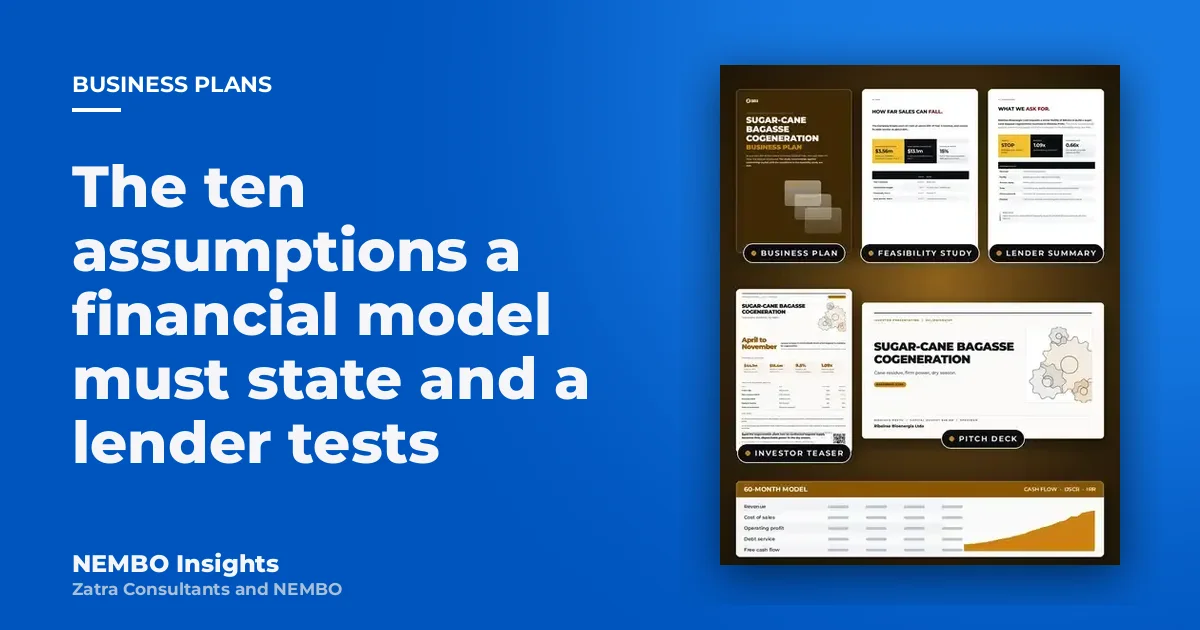
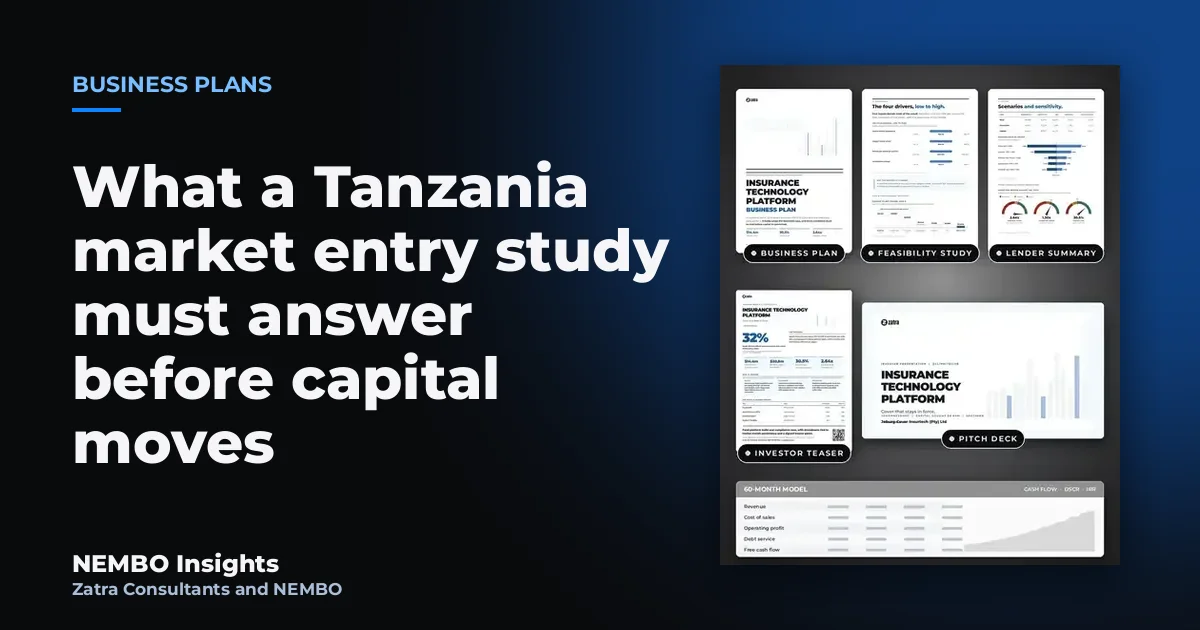
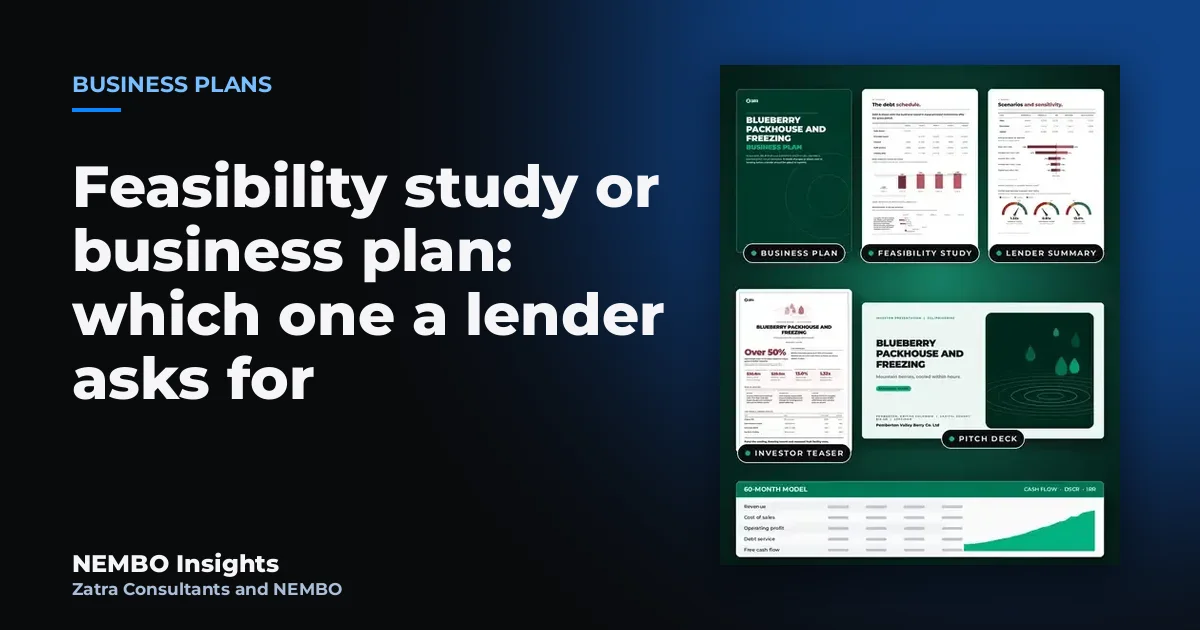
The NEMBO plan desk, authored and checked by Zatra Consultants Limited, prepares six files for a sector from one set of figures: the business plan, the feasibility study, a fourteen-page lender summary, an investor deck, a one-page teaser and a 60-month Excel model with a Base, Downside and Upside switch. The verdict, GO, REVISE or STOP, sits on page one and comes from written tests on project IRR, debt service cover and the evidence behind demand.
Plans are scoped and quoted in writing, and the quote states the delivery date. The desk does not decide or guarantee the decision of any bank, authority or investor.
Plan and feasibility study from one set of figures
The desk prepares the business plan, the feasibility study, the lender summary and the 60-month model, with the verdict on page one.
Open the plan deskSources and status
Accurate as at 17 October 2026. Every figure below was read at the source named, on the date shown.
- 1Manual for the Preparation of Industrial Feasibility StudiesUnited Nations Industrial Development Organization (UNIDO), 1978. Accessed 17 October 2026.
- 2Certificate of IncentivesTanzania Investment and Special Economic Zones Authority (TISEZA), undated. Accessed 17 October 2026.
- 3SME LoansNMB Bank Plc, undated. Accessed 17 October 2026.
- 4SME Bidii loanCRDB Bank, undated. Accessed 17 October 2026.
- 5Key Issues in Developing Project Financed TransactionsWorld Bank Group, ppp.worldbank.org, undated. Accessed 17 October 2026.
- 6Monetary Policy ReportBank of Tanzania, January 2026. Accessed 17 October 2026.
- 7Tanzania Agricultural Development Bank Phase II, Project Appraisal ReportAfrican Development Bank, 12 December 2023. Accessed 17 October 2026.
Figures to confirm before you act
- The documents a branch requires with an SME application, with the branch concerned.
- The current NMB and CRDB loan bands and eligibility points, with each bank.
- The TISEZA document list, capital minimum and fee in force, with TISEZA.
- The discount rate and payback limit a lender applies, with the lender's credit officer.
- The current range of lending rates, with the Bank of Tanzania.
This article is general information based on official sources available at the date of publication. It is not legal, tax, valuation or financial advice. Laws and notices change. Verify with the issuing authority or consult Zatra Consultants Limited before acting.
Frequently asked questions
Is a feasibility study the same as a business plan?
No. A feasibility study decides whether a project should proceed, using NPV, IRR and payback against fixed thresholds. A business plan sets out how the approved project is financed, staffed and run. One set of figures can feed both, so the verdict and the plan do not diverge.
Does a Tanzanian bank require a feasibility study?
The NMB and CRDB SME pages read on 17 October 2026 name no feasibility study and publish no document checklist. They list eligibility points such as steady cash flow. The branch's written list governs, and a borrower asks for it before preparing any file.
Does TISEZA require a business plan?
The TISEZA certificate of incentives page lists a project business plan and evidence of sufficient finance among eight documents. It states fees of TZS 4,000,000 for a local majority shareholder and TZS 6,000,000 for a foreign majority or joint shareholding.
What discount rate should a feasibility study use?
The rate is stated and tied to the cost of finance. The example uses 16 percent, the top of the 15 to 16 percent overall lending range the Bank of Tanzania reported for 2025. A lender or investor may apply its own rate, and the study shows the result at that rate.
What payback period is acceptable?
No payback limit is published on the pages read. The limit is set by the lender and by the loan tenor. The example uses 4 years as an assumption, and the study states the limit it applies beside the result.
When does a study return STOP?
A study returns STOP when the project fails the written tests, for example NPV below zero at the stated discount rate. In the example, a 20 percent cash shortfall turns NPV from plus TZS 56.0 million to minus TZS 195.2 million.
Which comes first, the study or the plan?
The study comes first, because it decides whether the plan is worth writing. Once the verdict is GO, the plan reuses the same cash flows, adds the operation, staffing, approvals and funding, and is submitted with the application.