On this page
- What must a market entry study answer before capital is committed?
- Which incentive route applies, and what capital does it need?
- In what order do registrations and licences fall?
- What do tax and the macro figures change in an entry budget?
- Worked example: a fictional entry sequence
- What the NEMBO desk prepares
- Sources and status
- Frequently asked questions
What must a market entry study for Tanzania answer?
A study answers seven questions: demand, competitors, licences, the incentive route, tax, logistics and sequence. TISEZA requires project capital of at least USD 500,000 for foreign or joint venture projects and USD 50,000 for citizen-owned projects, with a fee of TZS 4,000,000 or TZS 6,000,000.
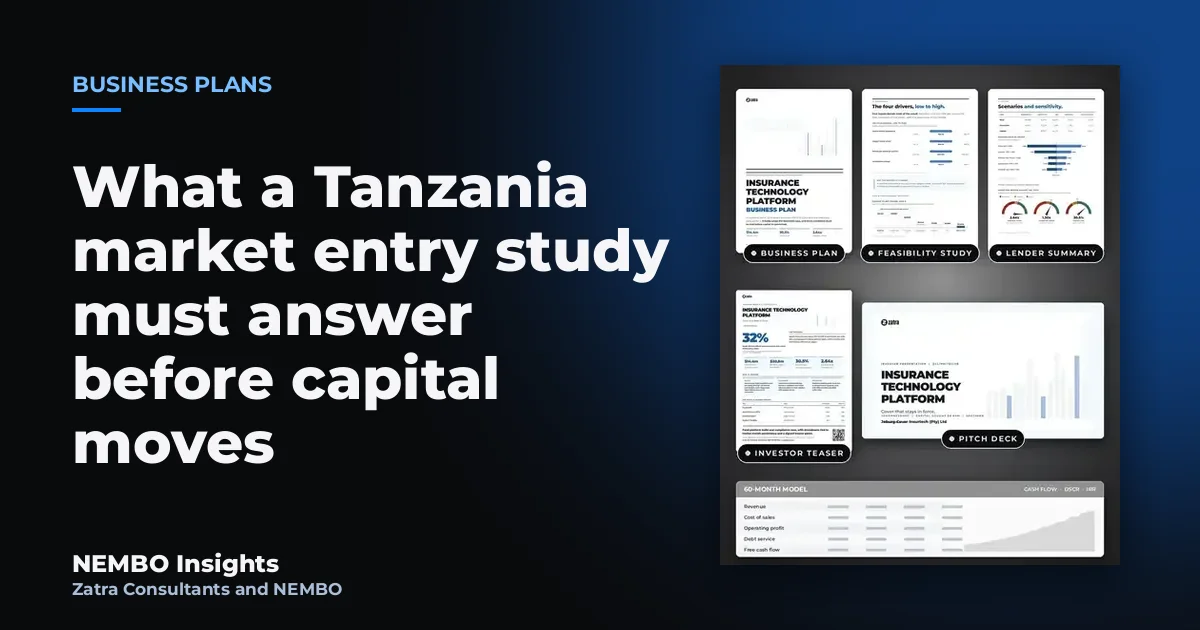
An investor with capital and a product often commits money before the questions that decide the entry are answered: whether the activity is open to the entity, who buys, which licences fall in which order and which incentive route applies. A market entry study answers those questions first and states the cost and date of each step. This note sets out what it must settle for Tanzania.
What must a market entry study answer before capital is committed?
A study answers seven questions in a fixed order: demand, competitors, licences, the incentive route, tax, logistics and the sequence of steps. The first test is whether the activity is open to the entering entity, because every later figure is wasted if it is not. The verdict is to enter, enter in stages or stop. The UNIDO manual places such studies in the pre-investment phase, before the investment decision 9.
| Question | What the study states | Where the answer sits |
|---|---|---|
| Demand | Buyers, volumes and prices, each dated | Buyer evidence and dated market data |
| Competitors | Named competitors, prices and channels as published | Published price lists and regulator registers |
| Licences | Business licence group, sector approvals, order | TISEZA and the sector regulator 3 |
| Incentive route | Certificate, minimum capital, fee | TISEZA 1 |
| Tax | Corporate income tax, VAT, TIN | Tanzania Revenue Authority 46 |
| Logistics | Entry port, storage, delivery time to the buyer | Port and carrier tariffs, dated |
| Sequence | Order, duration and cost of each step | TISEZA, BRELA and TRA pages 234 |
Which incentive route applies, and what capital does it need?
TISEZA issues the certificate of incentives under Part III, section 19 of the Investment and Special Economic Zones Act, 2025 1. Project capital must be at least USD 50,000 for a project wholly owned by Tanzanian citizens and at least USD 500,000 for a project wholly owned by foreign investors or set up as a joint venture 1. The fee is TZS 4,000,000 where a local shareholder holds the majority and TZS 6,000,000 for a foreign majority or joint shareholding 1.
Eight documents go to the TISEZA portal as PDFs: the certified certificate of incorporation, the memorandum and articles, the application form, a project business plan, evidence of sufficient finance, evidence of the project location, a board resolution and a covering letter 1. Mining and petroleum enterprises follow the approval processes of the Mining Act 2010 and the Petroleum Act 2015 1. TISEZA states that an investor registers with it before starting operations, whether or not incentives are sought 5.
In what order do registrations and licences fall?
Incorporation comes first, because the later documents depend on the certificate of incorporation. The sequence below follows the TISEZA pages read.
- Incorporation. BRELA registration through its online system; Tanzanians need a National Identification Number and a TIN, and foreign companies a passport number 2.
- Tax registration. A TIN issued by the Tanzania Revenue Authority, with no fee charged 4.
- Sector approval. Required where a law regulates the activity, and listed among the business licence documents 3.
- Business licence. Group A for regulated or national activities and Group B for others; the documents include the TIN, tax clearance, a lease or title deed and evidence of shareholders' nationality 3.
- Certificate of incentives. Lodged with the plan and evidence of finance once the entity exists 1.
What do tax and the macro figures change in an entry budget?
They fix the rates the budget uses. The Tanzania Revenue Authority lists corporate income tax at 30 percent and VAT at 18 percent 6. The Bank of Tanzania raised the Central Bank Rate to 6.25 percent on 2 July 2026 7, and its January 2026 report records overall lending rates of 15 to 16 percent in 2025 and a shilling range of 2,432.77 to 2,471.73 per US dollar in the fourth quarter 8. A study dates each rate and refreshes it at the entry date.
Worked example: a fictional entry sequence
Study 20, incorporation 10, sector approval 30, licence 15.
The seven steps added together, before overlap.
The TIN, clearance and certificate run beside the sector approval.
USD 1,350,000 against the USD 500,000 foreign minimum.
Source: NEMBO computation; capital, fee and document rules from the TISEZA Certificate of Incentives page, read 17 October 2026.
Note: illustrative; step durations are planning allowances, not published times; capital is stated at cost on an IFRS Accounting Standards basis. Nothing here is an offer or a guarantee.
What the NEMBO desk prepares
The NEMBO market entry desk, authored and checked by Zatra Consultants Limited, returns a study of demand and buyers, a competitor map with published prices and channels, the regulatory route in the order it falls with the issuing institution, two or three entry structures compared on cost, time and control, the cost and time of each step, and a verdict to enter, enter in stages or stop. The activity is tested against the activities reserved for citizens before any spend.
Studies are scoped and quoted in writing, and the quote states the date; where real data does not yet exist, it is gathered first. A study is not legal, tax or investment advice, and a licence position is confirmed with the issuing institution before filing.
A market entry study with the route and the order
The desk prepares the study of demand, competitors, licences and registrations in the order they fall, with the cost and time of each step and a verdict.
Open the market entry deskSources and status
Accurate as at 17 October 2026. Every figure below was read at the source named, on the date shown.
- 1Certificate of IncentivesTanzania Investment and Special Economic Zones Authority (TISEZA), undated. Accessed 17 October 2026.
- 2Company RegistrationTanzania Investment and Special Economic Zones Authority (TISEZA), undated. Accessed 17 October 2026.
- 3Business LicenseTanzania Investment and Special Economic Zones Authority (TISEZA), undated. Accessed 17 October 2026.
- 4Tax Identification Number (TIN)Tanzania Investment and Special Economic Zones Authority (TISEZA), undated. Accessed 17 October 2026.
- 5TISEZA history and servicesTanzania Investment and Special Economic Zones Authority (TISEZA), undated. Accessed 17 October 2026.
- 6Taxes and Duties 2023/2024Tanzania Revenue Authority (TRA), July 2023. Accessed 17 October 2026.
- 7Monetary Policy Committee statement, MPC No. 244Bank of Tanzania, 3 July 2026. Accessed 17 October 2026.
- 8Monetary Policy ReportBank of Tanzania, January 2026. Accessed 17 October 2026.
- 9Manual for the Preparation of Industrial Feasibility StudiesUnited Nations Industrial Development Organization (UNIDO), 1978. Accessed 17 October 2026.
Figures to confirm before you act
- The capital minimum, fee and document list for the certificate of incentives, with TISEZA.
- The processing time of each registration and approval, with the issuing institution.
- The sector approval and licence group for the activity, with the sector regulator and TISEZA.
- The corporate income tax and VAT position on the entry date, with the Tanzania Revenue Authority.
- The BRELA registration fee for the entity, with BRELA.
This article is general information based on official sources available at the date of publication. It is not legal, tax, valuation or financial advice. Laws and notices change. Verify with the issuing authority or consult Zatra Consultants Limited before acting.
Frequently asked questions
What capital does TISEZA require for a certificate of incentives?
The TISEZA page states at least USD 50,000 for a project wholly owned by Tanzanian citizens and at least USD 500,000 for a project wholly owned by foreign investors or set up as a joint venture. The study tests the budget against the applicable minimum first.
What does a TISEZA certificate of incentives cost?
The page states a fee of TZS 4,000,000 for a company with a local majority shareholder and TZS 6,000,000 for a company with a foreign majority or joint shareholding. The fee in force is confirmed with TISEZA before the application is lodged.
Must an investor register with TISEZA if no incentives are sought?
TISEZA states that an investor registers with it before starting operations, whether or not fiscal incentives are sought. The registration route and the incentive certificate are separate steps, and the study lists both with the issuing body.
Which documents does the certificate application need?
Eight: the certified certificate of incorporation, the memorandum and articles, the TISEZA application form, a project business plan, evidence of sufficient finance, evidence of the project location, a board resolution and a covering letter, all as PDFs.
How long does a TISEZA certificate take?
The certificate page read states no processing time. The example uses a 20 working day planning allowance, which is an assumption. The study states the time confirmed with TISEZA, and the written quote states the study's own delivery date.
What corporate tax rate does an entry budget use?
The Tanzania Revenue Authority's Taxes and Duties publication of July 2023 lists 30 percent for resident and non-resident corporations and 18 percent VAT. The budget uses the rates in force on the entry date, confirmed with the Authority.
Do mining projects follow the same incentive route?
TISEZA states that mining and petroleum enterprises follow the approval processes in the Mining Act 2010 and the Petroleum Act 2015. The study therefore names the sector regulator's route before the TISEZA steps.