On this page
- What does an investor look for first in a business plan?
- Why does the verdict go on page one?
- Which three figures carry the verdict?
- How is debt service cover worked out?
- How should demand evidence be tagged?
- Which approvals come before any figure is read?
- What tax assumptions does a reader test?
- Which reporting basis should the model name?
- What does the 60-month model need to contain?
- What does the verdict page contain?
- What makes a reader stop?
- How does a reader move from the verdict to the detail?
- Where does Zanzibar differ?
- How Zatra Consultants and NEMBO handle this
- What to do now
- Sources and status
- Frequently asked questions
How does an investor read a business plan?
An investor reads a business plan in a fixed order: the verdict on page one, then project IRR, debt service cover and the downside case, then the evidence behind demand, then the order of approvals. The story is read last. A plan that states these early, with sources and a named reporting basis, lets the reader reach a decision without hunting.
A credit officer, a development-finance analyst or a private investor opens a business plan with a decision already queued: ask for a meeting, ask for clarification, or decline. The founder spent months on the document. The reader gives the first pages a short, structured read, and those pages usually settle which of the three follows.
The tension is specific. A plan that opens with company history and a mission statement makes the reader hunt for the return, the loan cover and the approvals. A reader who has to hunt stops. The plan that earns a meeting states early what it concludes, and shows in the same pages the figures that would make the conclusion wrong.
What does an investor look for first in a business plan?
A decision-maker looks for four things before the story: the verdict, the numbers that carry it, the evidence for demand, and the order of approvals. The story still belongs in the plan. It is read after the reader has a reason to read it.
The order matters because each item answers a different objection. The verdict answers whether the case clears the tests the reader applies. The numbers answer whether the verdict is earned. The demand evidence answers whether the revenue line is real. The approvals answer whether the project can lawfully start in the month the model assumes.
Why does the verdict go on page one?
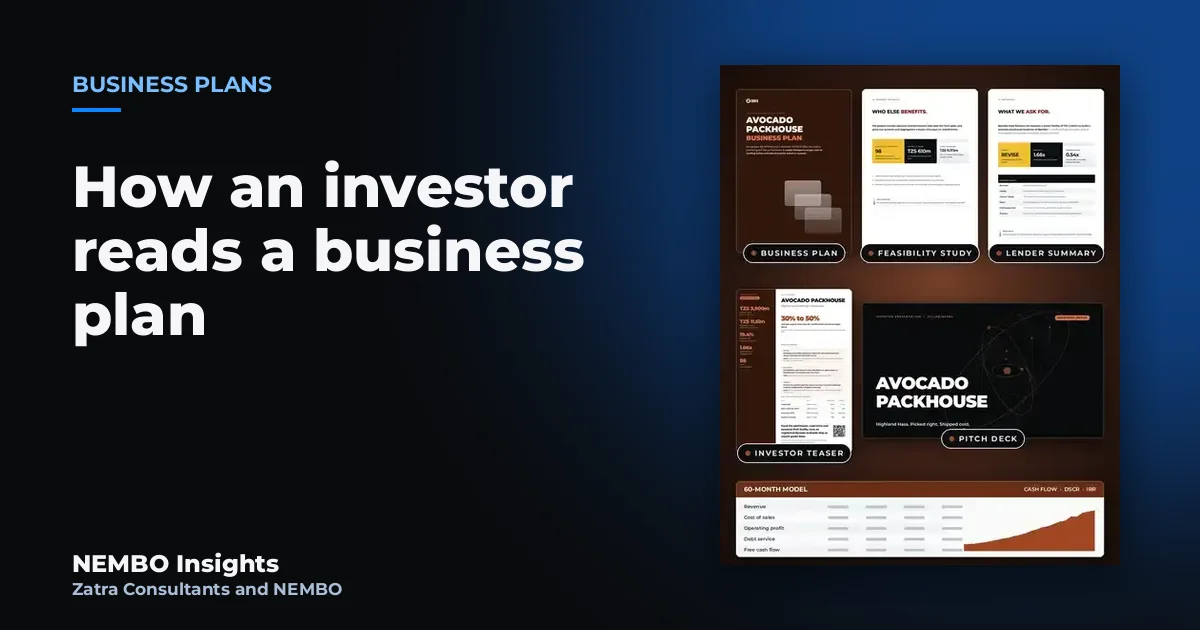
The NEMBO plan format puts the verdict on page one as GO, REVISE or STOP. The verdict is worked out from written tests on project IRR, debt service cover and the evidence behind demand. The same tests apply to every sector, so no single case can be tuned by hand.
A verdict of REVISE is useful to the reader and to the founder. It names the test that failed and the change that would clear it. A plan that can only say GO is a sales document. A plan that can say STOP, and has said it on a weak case, is one a lender can rely on when it says GO.
Which three figures carry the verdict?
Three figures do most of the work. Project IRR shows what the project returns before financing, so the reader can judge the asset apart from the loan. Debt service cover shows whether operating cash meets the scheduled loan payments. The third is the downside case, because a plan that works only in the base case is a forecast, not a plan.
- Project IRR, stated with the assumptions behind it: price, volume, cost and the month revenue starts.
- Debt service cover, shown in the base case and in the downside case.
- A 60-month model whose inputs can be changed and whose outputs follow without manual correction.
| Figure | Question the reader asks | What the plan must show beside it |
|---|---|---|
| Project IRR | Does the asset earn a return before financing? | Price, volume and cost assumptions; the month revenue starts |
| Debt service cover | Does operating cash meet the loan payments? | Scheduled debt service by year; base and downside values |
| Downside case | Does the plan survive a weaker year? | The size of the shock and which line it hits |
| Cash runway | How many days of cost can cash carry? | Opening cash and daily operating cost |
How is debt service cover worked out?
Debt service cover is operating cash flow for a year divided by the scheduled debt service for the same year. A result above 1.00 means operating cash covers the payments. The level a lender accepts is set by the lender, so the plan states the figure and the reader applies the lender's own threshold.
How should demand evidence be tagged?
Claims about customers are the easiest to inflate. Each buyer segment in the plan carries one of three tags: Proven, Indicated or Assumed. Proven means a source or a signed commitment exists. Indicated means the evidence points that way. Assumed means the plan depends on a belief that has not been tested.
A reader who can see the tag can see where the risk sits. A plan in which every segment is tagged Proven invites the question of what the sources are. A plan that tags a segment Assumed and prices the downside has shown the reader where to look.
| Tag | Meaning | Proof the reader can check |
|---|---|---|
| Proven | A source or signed commitment exists | Signed offtake agreement, purchase order, or a published dataset cited by title and date |
| Indicated | Evidence points that way | Letters of intent, survey results, pilot sales with the sample size stated |
| Assumed | A belief not yet tested | The assumption written out, with the downside if it fails |
Which approvals come before any figure is read?
Reserved and restricted activities, licences and the order of registrations come before a reader trusts the timeline. A project that cannot lawfully start in the planned month has a different timeline from the one in the model, and a reader who spots that early trusts the rest less.
Several approvals are published in primary texts. The Investment and Special Economic Zones Act, Act No. 6 of 2025, provides that an investor shall be registered with the Authority before commencing investment activities, and that the registration procedure is set in regulations 1. The Authority is TISEZA, which merged the former Tanzania Investment Centre and the Export Processing Zones Authority 2. The Act repealed the Tanzania Investment Act of 2022, the Export Processing Zones Act of 2002 and the Special Economic Zone Act of 2006 1.
Corporate records sit beside investment registration. The Companies Act, Revised Edition 2023, as published by BRELA, requires a company to keep accurate and up to date records of its beneficial owners, and carries a duty to deliver annual returns 3. BRELA operates a beneficial ownership portal whose filer roles are Director and Secretary 4. A plan lists these in the order the project needs them, with the body that issues each one.
| Order | Item | Issuing body | Source |
|---|---|---|---|
| 1 | Company incorporation and beneficial ownership records | BRELA | 34 |
| 2 | Investor registration before investment activities begin | TISEZA | 12 |
| 3 | Certificate for investment outside a special economic zone, or licence inside one, where sought | TISEZA | 1 |
| 4 | Tax registration and VAT where turnover requires it | Tanzania Revenue Authority | 5 |
| 5 | Sector licences for reserved or regulated activities | The sector regulator named in the plan | Plan states the regulator |
What tax assumptions does a reader test?
A reader checks the model against published rates. The Tanzania Revenue Authority publishes the standard VAT rate as 18 percent, with exports charged at 0 percent. It publishes mandatory registration once taxable turnover reaches TZS 200 million in twelve months, or TZS 100 million in the six months ending the previous month, and a monthly return due on or before the 20th day of the following month 5. A model that applies a different rate without a stated reason loses the reader.
A plan also states which figures are VAT exclusive. Revenue, cost and debt service are compared on the same basis, or the cover ratio is overstated or understated by the tax.
Which reporting basis should the model name?
Every financial statement and model names its basis. For a company reporting under IFRS Accounting Standards, the presentation standard is IAS 1 today. IFRS 18, which replaces IAS 1, applies to annual periods beginning on or after 1 January 2027, with earlier application permitted, and adds defined subtotals for operating profit and for profit before financing and income taxes 6. A 60-month model that runs past that date states which presentation it follows.
The National Board of Accountants and Auditors (NBAA) issued TFRS 1, the report by those charged with governance, approved on 22 June 2020 and operative for periods beginning on or after 1 January 2021. It applies to all entities except those applying the Financial Reporting Standard for Micro Entities, which may opt in 7. A plan for a micro entity names that standard. A plan for a public body names IPSAS.
What does the 60-month model need to contain?
A reader wants to change one input and watch the outputs follow. The model therefore separates inputs from calculations, and states each input once.
- An inputs sheet: price, volume, unit cost, wage bill, loan terms, tax rates and the month each begins.
- Monthly cash flow for 60 months, rolled up to years for the verdict page.
- A downside switch that applies a named shock, such as operating cash down by a quarter.
- A statement of the reporting basis, and of whether figures are VAT inclusive or exclusive.
- A checks row that shows the balance sheet balances and cash reconciles.
What does the verdict page contain?
The verdict page is one page. It carries the verdict word, the three test results, the demand tag count and the first approval date. Nothing on it requires the reader to turn a page to find a number.
| Block | Content | Rule |
|---|---|---|
| Verdict | GO, REVISE or STOP | One word, set by the written tests |
| Test results | Project IRR, debt service cover, downside cover | Each with its assumption beside it |
| Demand | Count of segments tagged Proven, Indicated and Assumed | Share of year-one revenue in each tag |
| Approvals | First approval needed and its issuing body | Month it must be in hand |
| Basis | Reporting basis and VAT treatment | Stated once, applied throughout |
What makes a reader stop?
Four faults stop a reader early. The first is a headline return with no assumptions beside it. The second is a debt service figure that mixes VAT inclusive revenue with VAT exclusive cost. The third is a timeline that begins revenue before the licence that permits it. The fourth is a demand claim with no tag and no source.
Each fault is a matter of order and labelling, not of the underlying business. A sound project can be returned for revision on any of them, and a plan that has already removed them lets the reader spend time on the merits.
How does a reader move from the verdict to the detail?
After page one the reader goes to the section that carries the weakest tag or the lowest cover. The plan therefore cross-references: each figure on the verdict page points to the page of its workings, and each Assumed segment points to the test that would convert it to Indicated. A plan built this way is read as an index first and as a narrative second.
The same logic governs appendices. Registrations, quotations from suppliers, signed commitments and the model itself sit at the back, each listed on the verdict page by title and date, so the reader can check a claim without searching.
Where does Zanzibar differ?
Zanzibar has its own registry and its own revenue authority, so a plan that covers both parts of the country confirms each separately. Business and Property Registration Agency (BPRA) issues registration documents for companies operating in Zanzibar, and a published commentary records that Mainland companies were moved from a branch route to a Zanzibar subsidiary after a Public Notice of 21 September 2021 8. The Zanzibar Revenue Authority issues a ZRA registration number, and its published guidance directs applicants to the ZIDRAS portal 9. The reader of a Zanzibar plan confirms the current position with BPRA and ZRA before acting.
How Zatra Consultants and NEMBO handle this
Zatra Consultants Limited authors and checks the content and the figures in a plan. NEMBO designs, produces and delivers the document. Short documents are targeted at under 30 minutes from complete details. Standard documents take hours. Research documents are dated in the written quote.
The desk does not decide or guarantee any bank's, panel's, officer's or authority's decision. A plan presents the case in the order a reader tests it. The outcome rests with the reader.
What to do now
- Write the verdict first. State GO, REVISE or STOP on page one, with the test behind it.
- Compute the three figures. Project IRR, debt service cover in the base and downside case, and cash runway.
- Tag every buyer segment. Mark each segment Proven, Indicated or Assumed, and attach the proof for the first two.
- List the approvals in order. Name the issuing body for each registration and licence, with the month each is needed.
- Name the reporting basis. State IFRS Accounting Standards, IAS, IPSAS or the micro-entity standard, and whether figures include VAT.
- Confirm with the issuing authority. Check rates, thresholds and procedures with TISEZA, BRELA, the Tanzania Revenue Authority and, for Zanzibar, BPRA and ZRA.
Business plans and feasibility studies
Verdict on the first page: GO, REVISE or STOP. Set by scope.
Share the details for business plans and feasibility studiesSources and status
Accurate as at 16 October 2026. Every figure below was read at the source named, on the date shown.
- 1The Investment and Special Economic Zones Act (Act No. 6 of 2025), English translationTanzania Investment and Special Economic Zones Authority (TISEZA), Act of 4 March 2025; translation GN No. 4 of 2026, 6 January 2026. Accessed 16 October 2026.
- 2TISEZA historyTanzania Investment and Special Economic Zones Authority (TISEZA), undated. Accessed 16 October 2026.
- 3The Companies Act, Revised Edition 2023Business Registrations and Licensing Agency (BRELA), Revised Edition 2023. Accessed 16 October 2026.
- 4Beneficial Ownership PortalBusiness Registrations and Licensing Agency (BRELA), undated. Accessed 16 October 2026.
- 5Value Added Tax (VAT)Tanzania Revenue Authority (TRA), undated. Accessed 16 October 2026.
- 6IFRS 18 Presentation and Disclosure in Financial StatementsIFRS Foundation, undated. Accessed 16 October 2026.
- 7Tanzania Financial Reporting Standard No. 1: The Report by Those Charged with GovernanceNational Board of Accountants and Auditors (NBAA), approved 22 June 2020. Accessed 16 October 2026.
- 8Significant Changes for Mainland Tanzania Businesses Operating in ZanzibarAfriwise, 13 October 2021. Accessed 16 October 2026.
- 9Get Help / FAQ: ZRA registrationZanzibar Revenue Authority (ZRA), undated. Accessed 16 October 2026.
Figures to confirm before you act
- Investor registration procedure, and the certificate or licence criteria, which the Act leaves to regulations: confirm with TISEZA.
- The VAT registration threshold and return deadline in force on the date of the plan: confirm with the Tanzania Revenue Authority.
- Beneficial ownership filing duties and annual return deadlines for the company: confirm with BRELA.
- The reporting basis the lender or investor requires, and whether IFRS 18 presentation is expected for periods from 1 January 2027: confirm with the reader and with NBAA.
- For any Zanzibar activity, registration and tax positions: confirm with BPRA and the Zanzibar Revenue Authority.
This article is general information based on official sources available at the date of publication. It is not legal, tax, valuation or financial advice. Laws and notices change. Verify with the issuing authority or consult Zatra Consultants Limited before acting.
Frequently asked questions
Does a business plan need a verdict on page one?
It is not a legal requirement. It is a reading aid. A reader who finds the conclusion and the tests behind it on the first page can judge quickly whether the rest deserves a full read, and can see exactly which test a weak case failed.
What is the difference between project IRR and equity IRR?
Project IRR measures the return on the asset before any financing. Equity IRR measures the return to the owner after debt. A plan shows both where debt is used, because a good equity return can hide a weak asset.
Why show a downside case at all?
A base case shows what management expects. A downside case shows whether loan payments survive a weaker year. The worked example above cuts operating cash by a quarter and shows cover falling from 1.60 to 1.20.
Can a plan use Assumed demand and still be credible?
Yes, when the tag is visible and the downside is priced. Credibility falls when assumptions are presented as facts. A reader forgives an honest Assumed tag more readily than an unsourced Proven one.
Is a 60-month model too long for a small business?
The length follows the loan or the payback period. A five-year view lets the reader see debt service, ramp-up and the downside across the full term. The monthly layout can be rolled up to years on the verdict page.
Who owns the figures in a plan?
The company owns its figures and assumptions. The document presents them with their sources. The reader, whether a bank, investor or authority, makes its own decision, and no document guarantees it.
Does a Zanzibar project need a separate plan?
It needs separate confirmation of registration and tax, because Zanzibar has its own registry and revenue authority. The plan can be a single document with a clearly marked Zanzibar section listing BPRA and ZRA steps.