On this page
- What is the difference between a quotation, a pro-forma invoice and a tax invoice?
- What does a quotation have to say?
- When is a pro-forma invoice used?
- What makes a tax invoice valid?
- What is the difference between a tax invoice and a fiscal receipt?
- How do the three documents run in one deal?
- Does a deposit change the document?
- What are the common errors?
- What does the buyer's finance team check on arrival?
- Why does the order of arrival matter?
- Where does Zanzibar differ?
- How Zatra Consultants and NEMBO handle this
- What to do now
- Sources and status
- Frequently asked questions
What is the difference between a quotation, a pro-forma invoice and a tax invoice in Tanzania?
A quotation is an offer with a price, a validity date and delivery terms. A pro-forma invoice requests payment before goods ship or work starts and creates no tax record. A tax invoice records a completed taxable sale and supports the buyer's input tax claim. Validity, fiscal receipt and Zanzibar treatment are confirmed with the Tanzania Revenue Authority or the Zanzibar Revenue Authority.
A buyer's finance clerk receives a document headed Invoice for goods not yet delivered. The clerk cannot pay it, cannot post it and cannot claim the VAT on it. The seller meanwhile reads the silence as slow payment. Nobody has erred in bad faith: one document has been asked to do the work of three.
One sale can need a quotation, a pro-forma invoice and a tax invoice. They share a letterhead and a deal, and they are often swapped. Each answers a different question for a different reader, and the order they arrive in decides how quickly the payer can act.
What is the difference between a quotation, a pro-forma invoice and a tax invoice?
A quotation is an offer. A pro-forma invoice is a request for payment before delivery. A tax invoice is the record of a completed taxable sale. The first two create no tax record. The third does, and it is the document on which the buyer's input tax claim depends.
| Document | Job | Reader | Tax record |
|---|---|---|---|
| Quotation | Offer a price, terms and a validity date | Buyer deciding whether to order | None |
| Pro-forma invoice | Request payment before goods ship or work starts | Buyer's finance team, and the bank where a credit is involved | None |
| Tax invoice | Record a completed taxable sale | Buyer's accounts, and the tax authority | Yes: basis for the buyer's input tax claim |
What does a quotation have to say?
A quotation states what is offered, at what price, for how long the offer stands, and on what delivery terms. The useful parts are the validity date, the lead time and the deposit and balance schedule. A quotation that omits the validity date leaves the seller exposed to a price the market has since moved.
A quotation also states whether prices include VAT. The Tanzania Revenue Authority publishes the standard VAT rate as 18 percent, with exports charged at 0 percent 2. The Value Added Tax Act, Cap. 148, fixes the standard rate at eighteen percent in section 5(1) and zero-rates supplies under section 5(2) 1. A quotation that shows a net price, the VAT and the total on separate lines prevents a dispute at invoice stage.
When is a pro-forma invoice used?
A pro-forma invoice is sent before goods ship or work starts. It is a request for payment, not a record of a completed sale. In export trade it often accompanies a letter of credit application, so origin, packing, weights, bank details with SWIFT and a payment reference are the lines the payer's finance team matches first.
Where a documentary credit is involved, the credit sets the documents required. Credits are commonly issued subject to the ICC Uniform Customs and Practice for Documentary Credits, UCP 600, whose Article 18 is titled Commercial Invoice 5. The text of the credit, and the bank that issues it, decide what invoice is acceptable. The seller confirms the invoice wording with the bank before shipment.
What makes a tax invoice valid?
The Value Added Tax Act defines a tax invoice as a document issued in accordance with section 86 and regulations made under the Act 1. Section 35 requires a registered person to use a Taxpayer Identification Number and a VAT Registration Number on all documents required to be issued under the Act 1. Where retail prices omit VAT, section 38(1)(b) requires the receipt or invoice to state separately the total amount of VAT charged 1.
The layout carries both parties' tax IDs, a sequential number, and the taxable value, rate, tax and total together, so a reader cannot misread the total. What counts as a valid tax invoice, and when a fiscal receipt from an approved device is required, is set by the tax authority and not by a layout. A business confirms its own treatment with the Tanzania Revenue Authority or a tax adviser.
| Line | Why it is there | Source or rule |
|---|---|---|
| Seller TIN and VAT Registration Number | Identifies the registered supplier | Section 35, VAT Act 1 |
| Buyer TIN | Lets the buyer support an input tax claim | Confirm requirement with TRA |
| Sequential number | Makes every invoice traceable | Confirm requirement with TRA |
| Taxable value, rate, VAT, total | Shows the tax separately | Section 38(1)(b), VAT Act 1 |
| Date of issue | Starts the six-month input tax period for the buyer | Section 69(2), VAT Act 1; TRA VAT page 2 |
What is the difference between a tax invoice and a fiscal receipt?
The VAT Act recognises both. Section 69(3)(b) allows an input tax credit only with a valid tax invoice or fiscal receipt issued by the supplier under the Act 1. The Tanzania Revenue Authority publishes that input tax cannot be deducted after six months from the date of the tax invoice or EFD receipt 2.
The TRA e-fiscal device page describes four device types: Electronic Tax Register, Electronic Fiscal Printer, Electronic Signature Device and Electronic Fiscal Pump Printer. It states that a person using an EFD is obliged to issue a receipt or invoice on each sale, and that changes or malfunction of the machine must be notified to the Commissioner within 24 hours 3. Persons who are not VAT registered with turnover of TZS 11 million and above per year fall within the second phase of EFD use, together with certain sectors and prime locations 3.
The 2025 amendment to the VAT General Regulations, GN No. 352K, replaced the monthly return form and uses EFDMS as a data source for standard rated sales. It came into operation on 1 July 2025 4. The practical point for a seller is that the fiscal record and the invoice must agree, because the return is built on the fiscal data.
How do the three documents run in one deal?
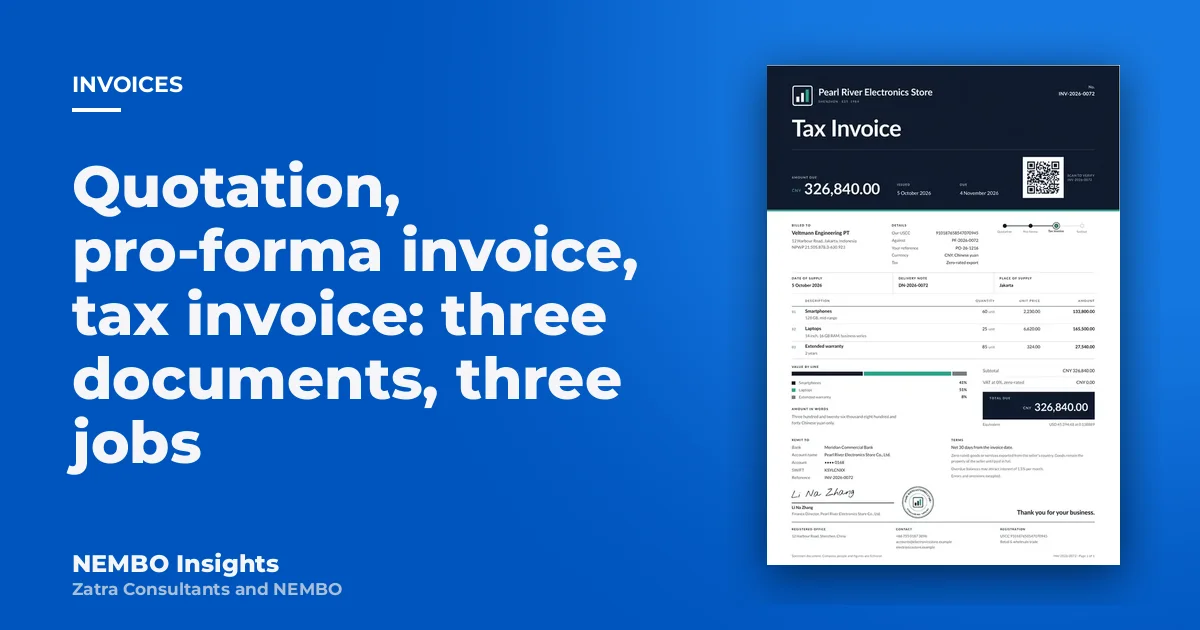
The NEMBO invoice set is built as one deal on one letterhead: quotation, then pro-forma, then tax invoice. A payer who sees three documents with the same identity, the same references and the same bank details has fewer reasons to pause. The reference on the quotation carries through to the pro-forma and the tax invoice, so the payer's finance team matches them without a query.
- Quotation: validity date, lead time, deposit and balance.
- Pro-forma: origin, packing, weights, bank details, payment reference.
- Tax invoice: both tax IDs, sequential number, value, rate, tax, total.
Does a deposit change the document?
A deposit requested on a pro-forma is a request for payment. Whether VAT arises when the deposit is received, and which receipt or invoice the supplier must then issue, is a matter for the tax authority. The seller confirms the treatment with the Tanzania Revenue Authority before the first deposit is taken, and records the answer in the quotation terms.
What are the common errors?
Most queries trace to a few faults. A quotation without a validity date. A pro-forma headed Tax Invoice. A tax invoice issued before delivery. A total that does not equal net plus VAT. A bank detail that differs between documents. Each is avoided by a single reference, one template and a check of arithmetic before issue.
| Stage | Document | Trigger | Check before issue |
|---|---|---|---|
| 1 | Quotation | Buyer enquiry | Validity date; VAT basis stated |
| 2 | Pro-forma invoice | Buyer accepts the quotation | Deposit equals the quoted share of the total; bank details match |
| 3 | Goods delivered or work completed | Delivery note or completion record | Quantities match the order |
| 4 | Tax invoice, and fiscal receipt where required | Completed taxable sale | Tax IDs, number, value, rate, VAT, total; arithmetic exact |
What does the buyer's finance team check on arrival?
A finance team checks four things in sequence: that the supplier is who the purchase order names, that the amount agrees with the order, that the bank details match the supplier master record, and that the document is the right kind for the stage of the deal. A mismatch on any one holds the payment while the query is answered.
The seller can remove each query in advance. The legal name and tax identifiers on every document are the same. The order reference is quoted. The bank details are identical on the pro-forma and on the tax invoice, and any change of account is notified in writing separately from the invoice.
Why does the order of arrival matter?
The documents are read in the order they arrive. A quotation reaches the person who approves the spend. A pro-forma reaches the person who releases funds. A tax invoice reaches the person who posts the ledger and claims the tax. A document sent to the wrong stage lands on the wrong desk, and the deal waits while it is forwarded.
For this reason the set is issued in sequence and is not sent as a bundle. The quotation goes first and stands until its validity date. The pro-forma follows acceptance. The tax invoice follows delivery. Each document refers back to the one before it by reference, which gives the buyer a trail from offer to payment.
Where does Zanzibar differ?
Zanzibar has its own revenue authority and its own VAT law. The Mainland VAT Act refers to a taxable person registered under Zanzibar's VAT law in its provisions on zero-rating goods supplied to that person, so the two regimes are treated as distinct 1. The Zanzibar Revenue Authority issues a ZRA registration number, and its guidance directs applicants to the ZIDRAS portal and states that a trader with yearly sales above TZS 5,000,000 must register 6. A seller that invoices in both parts of the country confirms Zanzibar invoicing rules with ZRA, separately from Mainland rules with the Tanzania Revenue Authority.
How Zatra Consultants and NEMBO handle this
Zatra Consultants Limited authors and checks the content and the figures in an invoice set. NEMBO designs, produces and delivers the documents. Short documents are targeted at under 30 minutes from complete details. Standard documents take hours. Research documents are dated in the written quote.
A set shows the sample rate as illustrative and dated. The desk does not decide or guarantee any bank's, panel's, officer's or authority's decision, and it does not advise on a business's own tax treatment. That sits with the Tanzania Revenue Authority, the Zanzibar Revenue Authority or the business's tax adviser.
What to do now
- Fix one reference. Give the deal a single reference that appears on the quotation, the pro-forma and the tax invoice.
- Date the offer. Put a validity date, a lead time and the deposit and balance schedule on every quotation.
- Separate net, VAT and total. Show the three on separate lines, and check that net plus VAT equals the total.
- Label each document honestly. Head the request for payment as a pro-forma invoice, and issue the tax invoice only on a completed sale.
- Check the fiscal record. Confirm with the Tanzania Revenue Authority whether an EFD receipt is required for the sale, and keep the receipt and invoice consistent.
- Confirm Zanzibar separately. For Zanzibar sales, confirm registration and invoicing with the Zanzibar Revenue Authority.
Quotations, pro-forma and tax invoices
One deal. Three documents. One letterhead. Hours.
Share the details for quotations, pro-forma and tax invoicesSources and status
Accurate as at 16 October 2026. Every figure below was read at the source named, on the date shown.
- 1The Value Added Tax Act, Cap. 148Tanzania Revenue Authority (TRA), undated. Accessed 16 October 2026.
- 2Value Added Tax (VAT)Tanzania Revenue Authority (TRA), undated. Accessed 16 October 2026.
- 3E-Fiscal Devices (EFD)Tanzania Revenue Authority (TRA), undated. Accessed 16 October 2026.
- 4The Value Added Tax (General) (Amendment) Regulations, 2025, GN No. 352KTanzania Revenue Authority (TRA), 30 June 2025. Accessed 16 October 2026.
- 5UCP 600ICC Academy, International Chamber of Commerce, undated. Accessed 16 October 2026.
- 6Get Help / FAQ: ZRA registrationZanzibar Revenue Authority (ZRA), undated. Accessed 16 October 2026.
Figures to confirm before you act
- The content and numbering requirements for a valid tax invoice under section 86 of the VAT Act and its regulations: confirm with the Tanzania Revenue Authority.
- Whether an EFD or VFD receipt is required for the sale and the business's turnover: confirm with the Tanzania Revenue Authority.
- Whether VAT arises on a deposit received before delivery, and the document to issue: confirm with the Tanzania Revenue Authority.
- The invoice wording a documentary credit requires: confirm with the issuing bank.
- Invoicing and VAT rules for Zanzibar sales: confirm with the Zanzibar Revenue Authority.
This article is general information based on official sources available at the date of publication. It is not legal, tax, valuation or financial advice. Laws and notices change. Verify with the issuing authority or consult Zatra Consultants Limited before acting.
Frequently asked questions
Can a pro-forma invoice be used to claim input VAT?
No. The VAT Act allows an input tax credit with a valid tax invoice or fiscal receipt issued by the supplier. A pro-forma is a request for payment and is not that document, so the buyer waits for the tax invoice.
How long is a quotation valid?
The seller decides and states it. The validity date should be on the document. Without one, the seller may be held to a price the market has since moved, and the buyer cannot tell when the offer lapses.
Does the pro-forma need a different number from the tax invoice?
It needs its own document type and may share the deal reference. The tax invoice carries its own sequential number. Using the same number for both documents invites confusion in the buyer's ledger and the seller's fiscal records.
What does the TRA say about the six-month limit?
The Tanzania Revenue Authority publishes that input tax is not deducted or credited after six months from the date of the tax invoice or EFD receipt. A late invoice therefore costs the buyer the credit.
Is an EFD receipt the same as a tax invoice?
They are separate instruments, and the VAT Act names both as supporting an input tax credit. Whether a given sale needs one, the other or both depends on the seller's registration and the TRA's requirements.
Can one template serve Mainland and Zanzibar sales?
One design can serve both. The tax identifiers and rules differ, because Zanzibar has its own revenue authority and registration number. The template holds a field for each, and the seller confirms the Zanzibar content with ZRA.
Who confirms a business's own tax treatment?
The Tanzania Revenue Authority, the Zanzibar Revenue Authority for Zanzibar, or the business's tax adviser. The document designer lays out the information and does not decide the treatment.