On this page
- What is the difference between an EFD receipt and a VAT tax invoice?
- When does a seller issue an EFD receipt?
- When does a seller issue a VAT tax invoice?
- What must a buyer hold to claim input tax?
- How does the seller's return use these documents?
- What the NEMBO desk prepares
- Sources and status
- Frequently asked questions
When does a Tanzanian seller issue an EFD receipt and when a VAT tax invoice?
As read on 17 October 2026, TRA publishes an 18 percent standard VAT rate. The Value Added Tax Act accepts a valid tax invoice or a fiscal receipt from the supplier as support for an input tax credit, claimed within six months of the document date. Which instrument a seller issues depends on its device and registration, confirmed with TRA.
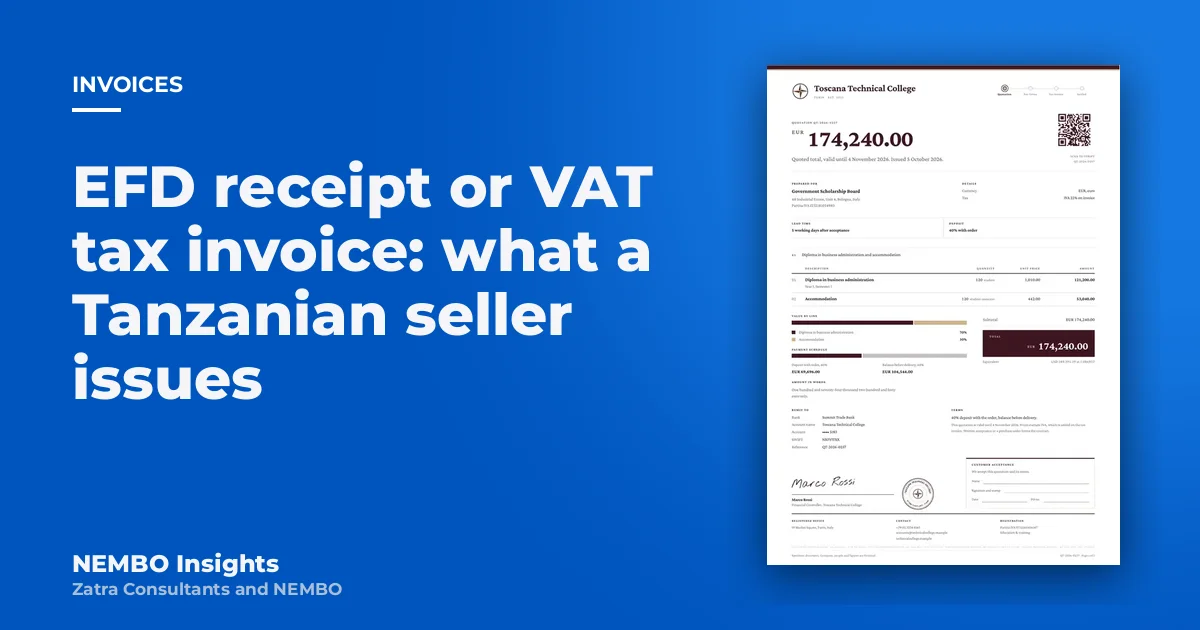
A buyer's accounts clerk holds a thermal EFD receipt from one supplier and a typed invoice from another. Both carry a TIN. Only a valid document of the right kind supports the VAT the buyer expects to recover, and the clerk learns which at return time, when the six-month limit may have run.
This note separates the two instruments, sets out what the Value Added Tax Act and the Tanzania Revenue Authority (TRA) publish about each, and computes the input tax at stake on a fictional purchase at the 18 percent standard rate. The sequence before supply, quotation then pro-forma, is treated in a separate note on the same desk 6.
What is the difference between an EFD receipt and a VAT tax invoice?
An EFD receipt is the fiscal record an electronic fiscal device produces on a sale. A VAT tax invoice is, in the Act's words, a document issued in accordance with its tax invoice section and regulations. Section 73(3)(b) of the Value Added Tax Act, Cap. 148 R.E. 2023, accepts either as support for an input tax credit when valid and issued by the supplier 3.
| Point | EFD receipt | VAT tax invoice |
|---|---|---|
| What it is | Fiscal receipt, a term the Act takes from the Tax Administration Act 3 | Document issued under the Act's tax invoice section and regulations 3 |
| Device | Electronic Tax Register or Electronic Fiscal Printer for retail sales 2 | Electronic Signature Device signs a computer-produced invoice with a unique number 2 |
| Support for input tax | Accepted if valid and issued by the supplier 3 | Accepted if valid and issued by the supplier 3 |
| Time limit for the credit | Six months from the date of the receipt 1 | Six months from the date of the invoice 1 |
When does a seller issue an EFD receipt?
On each sale, where the seller falls within the EFD regime. TRA states that a person using an EFD is obliged to issue a receipt or invoice on each sale, and that failing to issue a fiscal receipt or fiscal invoice on receiving payment is an offence 2.
The second phase reaches traders who are not VAT registered with annual turnover of TZS 11 million and above, traders in prime areas and traders in selected sectors such as spare parts, hardware and pharmacies 2. VAT registration becomes mandatory when taxable turnover reaches TZS 200 million within twelve months 1. An EFD receipt therefore does not by itself show that VAT was charged, and the buyer reads the receipt for a VAT amount before treating it as support for a credit.
When does a seller issue a VAT tax invoice?
A seller that produces its invoices by computer has them signed through an Electronic Signature Device, which adds a unique signature number 2. Whether a given sale calls for a tax invoice, an EFD receipt or both is confirmed with TRA. The particulars a valid tax invoice must carry are prescribed by the Act and its regulations.
What must a buyer hold to claim input tax?
A valid tax invoice or fiscal receipt issued by the supplier, held when the return is filed, and a claim made within six months of the document date 13.
- The supplier's name and TIN agree with the purchase order.
- The document is a tax invoice or an EFD receipt, not a pro-forma or a delivery note.
- VAT appears as its own line, at 18 percent where the supply is standard rated 1.
- The date is recorded, because the six-month limit runs from it 1.
- The total equals net plus VAT.
How does the seller's return use these documents?
The Value Added Tax (General) (Amendment) Regulations, 2025 (GN No. 352K), in operation from 1 July 2025, replaced the monthly return with Form ITX 240.02.B. The form separates standard-rated sales recorded in EFDMS from standard-rated sales not recorded in EFDMS, which are keyed manually 4. A seller's fiscal records and its invoices therefore have to agree, because a standard-rated sale outside the system is entered by hand.
Source: TRA VAT page, read 17 October 2026 (18 percent rate, six-month limit); Value Added Tax Act, Cap. 148 R.E. 2023, section 73(3)(b).
Note: illustrative figures for a fictional company, presented on an IFRS basis with recoverable VAT excluded from cost. Nothing here is an offer, tax advice or a guarantee of any authority's decision.
What the NEMBO desk prepares
The Client shares the business, the items, the prices and the tax details. Zatra Consultants Limited checks the content and the figures, and NEMBO returns the quotation, the pro-forma invoice and the tax invoice on one letterhead, one A4 page each, with the amount in words matched to the total 5. The tax invoice carries both tax numbers, a sequential number, and the taxable value, rate, tax and total in one block, with a fiscal reference where the country runs one.
The set is delivered in hours and quoted in writing. The desk lays out the information. It does not decide the Client's tax treatment, and it does not guarantee the decision of TRA or of any buyer's auditor.
Quotation, pro-forma and tax invoice on one letterhead
The desk prepares the quotation, the pro-forma invoice and the tax invoice on the Client's details, one A4 page each, with the amount in words matched to the total.
Share the invoice detailsSources and status
Accurate as at 17 October 2026. Every figure below was read at the source named, on the date shown.
- 1Value Added Tax (VAT)Tanzania Revenue Authority (TRA), undated. Accessed 17 October 2026.
- 2E-Fiscal Devices (EFD)Tanzania Revenue Authority (TRA), undated. Accessed 17 October 2026.
- 3The Value Added Tax Act, Cap. 148 R.E. 2023Tax Revenue Appeals Board (hosted copy), undated. Accessed 17 October 2026.
- 4The Value Added Tax (General) (Amendment) Regulations, 2025, GN No. 352KTanzania Revenue Authority (TRA), 30 June 2025. Accessed 17 October 2026.
- 5Invoices: quotation, pro-forma and tax invoiceNEMBO, undated. Accessed 17 October 2026.
- 6Quotation, pro-forma invoice, tax invoice: three documents, three jobsNEMBO, 14 October 2026. Accessed 17 October 2026.
Figures to confirm before you act
- The particulars a valid tax invoice must carry for the supply, with the Tanzania Revenue Authority.
- Whether the sale requires an EFD receipt, a signed tax invoice or both, and the seller's phase of EFD use, with the Tanzania Revenue Authority.
- The standard rate and the six-month limit on the day the return is filed, with the Tanzania Revenue Authority.
- Invoicing and VAT treatment of sales in Zanzibar, with the Zanzibar Revenue Authority.
- The input tax position on a specific purchase, with the Client's tax adviser.
This article is general information based on official sources available at the date of publication. It is not legal, tax, valuation or financial advice. Laws and notices change. Verify with the issuing authority or consult Zatra Consultants Limited before acting.
Frequently asked questions
Is an EFD receipt the same as a VAT tax invoice?
No. The Act names both and accepts either, when valid and issued by the supplier, as support for an input tax credit. An EFD receipt is produced by a fiscal device on a sale. A tax invoice is a document issued under the Act's tax invoice section and regulations, and a signature device signs one produced by computer.
Can a buyer claim input VAT on an EFD receipt?
Yes, where the receipt is valid, issued by the supplier and shows VAT. Section 73(3)(b) of the Value Added Tax Act accepts a fiscal receipt. The buyer holds it when the return is filed and claims within six months of its date.
How long does a buyer have to claim input tax?
TRA publishes that input tax is not deducted or credited after six months from the date of the tax invoice or EFD receipt. An invoice dated 2 October 2026 therefore runs to 2 April 2027. The date on the document, not the date of receipt, starts the period.
Does an EFD receipt prove that VAT was charged?
No. TRA places traders who are not VAT registered, with turnover of TZS 11 million and above, in the second phase of EFD use, and VAT registration is mandatory only from TZS 200 million in twelve months. The buyer checks that the receipt shows a VAT amount.
Can a pro-forma invoice support an input tax claim?
No. A pro-forma requests payment before supply and is neither a tax invoice nor a fiscal receipt. The buyer waits for the tax invoice or EFD receipt issued on the completed sale, and the six-month period runs from that date.
At what turnover must a seller register for VAT?
TRA states that registration is mandatory when taxable turnover reaches TZS 200 million within twelve months. A seller below that level may still hold an EFD, so the buyer reads each receipt for a VAT amount before claiming.