On this page
How is days sales outstanding calculated and what do invoice payment terms change?
Days sales outstanding is closing trade receivables divided by credit sales, multiplied by the days in the period. As read on 17 October 2026, CRDB's invoice discounting lends up to 70 percent of invoice value excluding tax over 30 to 90 days, on invoices outstanding below 60 days. A calendar due date fixes the obligation on the document.
An SME invoices TZS 520 million in a quarter, writes thirty days on every invoice and closes the quarter with TZS 230 million unpaid. The terms say thirty days. The ledger says 40.7. The difference is cash the business has lent to its customers, and it is the figure a lender reads before the profit.
This note sets out how payment terms and due dates are written, how days sales outstanding (DSO) is computed, and what a lender reads in receivables, using CRDB's published invoice discounting terms and the IFRS Foundation's treatment of expected credit losses.
What is days sales outstanding?
Days sales outstanding is closing trade receivables divided by credit sales for the period, multiplied by the days in the period. It states how many days of sales remain unpaid at the period end. Set against the days written on the invoice, it shows how many days late the average customer pays.
How should payment terms and due dates be written?
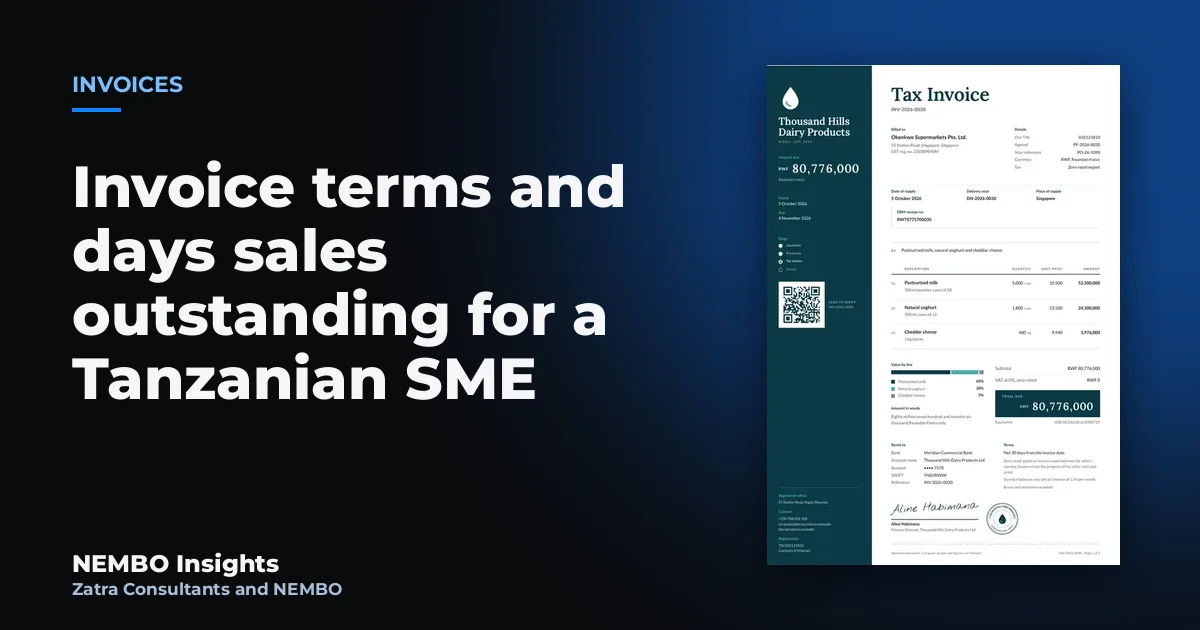
With a calendar due date as well as a count of days. An invoice dated 17 October 2026 on 30-day terms falls due on 16 November 2026, and the date removes the arithmetic from the payer's side. The invoice carries the bank details and a payment reference so the finance team matches the payment without a query. The invoice date matters to the buyer too, since TRA publishes that input tax is not deducted or credited after six months from the date of the tax invoice or EFD receipt 7.
| Wording on the invoice | What the payer must work out | Due date |
|---|---|---|
| 30 days | Count from the invoice date held on file | Varies with the date the invoice is received |
| Due 16 November 2026 | Nothing | Fixed on the document |
| Due 16 November 2026, reference INV-2610-07, named account | Nothing; the payment is matched by reference | Fixed and matched to the invoice |
A late-payment charge is stated only as a term the parties agreed, with the date it starts, and the Client's legal adviser confirms its wording. Deposits and balances are fixed on the quotation, as set out in a separate note 6.
What does a lender read in receivables?
Age, customer and conduct. CRDB's invoice discounting page states a loan of up to 70 percent of the supplier's tax invoice value excluding tax, a tenor of 30 to 90 days, a maximum of TZS 5 billion and a requirement that outstanding payments on an invoice be below 60 days 1. It looks for customers with a good record of account conduct and credit history, and for invoices from reputable organisations with a history of settling their obligations 1.
The Bank of Tanzania's Financial Stability Report of December 2024 records non-performing loans at 3.3 percent of banking-sector loans, down from 4.3 percent in December 2023, and lists government payment of arrears among the factors that improved corporate loan status 2. Receivables owed by public buyers are therefore a credit factor lenders read.
How do expected credit losses treat receivables?
IFRS 9 added the expected credit loss requirements in its July 2014 version, effective for annual periods beginning on or after 1 January 2018 4. The IFRS Foundation's July 2024 review records that IFRS 9 provides practical expedients, including a provision matrix for trade receivables, and that the simplified approach is working as intended 3. A provision matrix applies a loss rate to each ageing band. An entity under another framework follows that framework's rules.
Source: computed from the fictional figures in the worked example; lender conditions from CRDB Invoice Discounting Finance, read 17 October 2026.
Note: illustrative management figures on an IFRS basis, both receivables and sales inclusive of VAT. Nothing here is an offer, a credit decision or a guarantee.
What changes collection?
- Date the obligation. State the due date as a calendar date on the quotation and the invoice.
- Match the payment. Print the bank details and one payment reference on every invoice.
- Bill on the event. Issue the invoice on the day of supply, so the buyer's clock and the seller's start together.
- Age the ledger monthly. Compute DSO and the share of receivables over 60 days on a fixed date.
- Decide the lender file. Hold the tax invoice, the order and the delivery record for each financeable invoice.
What the NEMBO desk prepares
The Client shares the business, the items, the prices and the terms. Zatra Consultants Limited checks the content and the figures, and NEMBO returns the quotation with its deposit and balance schedule and the tax invoice with the due date, bank details with SWIFT, a payment reference and a verification QR carrying the number, total and due date 5. The set is delivered in hours and quoted in writing.
The desk prepares the documents. It does not set the Client's credit terms, and it does not guarantee collection or the decision of any lender.
Invoices with the due date and the payment reference built in
The desk prepares the quotation with its deposit and balance schedule, and the tax invoice with a due date, bank details with SWIFT, a payment reference and a verification QR.
Share the invoice detailsSources and status
Accurate as at 17 October 2026. Every figure below was read at the source named, on the date shown.
- 1Invoice Discounting FinanceCRDB Bank, undated. Accessed 17 October 2026.
- 2Tanzania Financial Stability Report, December 2024Bank of Tanzania, December 2024. Accessed 17 October 2026.
- 3Post-implementation Review of IFRS 9, Impairment: Project Summary and Feedback StatementIFRS Foundation, July 2024. Accessed 17 October 2026.
- 4IFRS 9 Financial InstrumentsIFRS Foundation, undated. Accessed 17 October 2026.
- 5Invoices: quotation, pro-forma and tax invoiceNEMBO, undated. Accessed 17 October 2026.
- 6Quotation, pro-forma invoice, tax invoice: three documents, three jobsNEMBO, 14 October 2026. Accessed 17 October 2026.
- 7Value Added Tax (VAT)Tanzania Revenue Authority (TRA), undated. Accessed 17 October 2026.
Figures to confirm before you act
- The current advance percentage, tenor and conditions of invoice discounting, with the CRDB branch.
- The late-payment charge a contract may state and its enforceability, with the Client's legal adviser.
- The reporting framework and the impairment method that apply to the entity, with the entity's accountant.
- The sector figures quoted from the Financial Stability Report, with the Bank of Tanzania.
- The six-month input tax limit on the day the return is filed, with the Tanzania Revenue Authority.
This article is general information based on official sources available at the date of publication. It is not legal, tax, valuation or financial advice. Laws and notices change. Verify with the issuing authority or consult Zatra Consultants Limited before acting.
Frequently asked questions
How is days sales outstanding calculated?
Divide closing trade receivables by credit sales for the period and multiply by the days in the period. With receivables of TZS 230 million and quarterly credit sales of TZS 520 million over 92 days, DSO is 40.7 days. Receivables and sales are taken on the same VAT basis.
What is a good DSO for an SME?
No benchmark is published on the sources read for this note. The useful comparison is DSO against the days written on the invoice, and against the lender's own condition. CRDB's invoice discounting page requires outstanding payments on an invoice below 60 days.
Does a due date on the invoice change collection?
It fixes the obligation on the document, so the payer does not count from a received date. It does not guarantee payment. A reference and bank details let the payer's finance team match the payment, which removes a common reason for a query.
Can an SME borrow against its invoices?
CRDB's page states that invoice discounting lends up to 70 percent of the supplier's tax invoice value excluding tax, to a maximum of TZS 5 billion, for 30 to 90 days, and requires a CRDB Biashara Account. The branch confirms current terms and decides each request.
Does an invoice carry interest on late payment?
Only if the contract states it. The agreed charge is written on the quotation and the invoice as a term, with the date it starts. The Client's legal adviser confirms the wording and its enforceability before the first invoice is issued.
Why does a lender read receivables before profit?
Repayment comes from collections. Age, customer quality and the share of old invoices show whether sales have become cash. Profit on an invoice unpaid after 90 days does not service a loan.