On this page
- Which ten assumptions must a financial model state?
- What do the published rates say about tax, interest and exchange?
- How does a lender stress-test the assumptions?
- Worked example: a 60-month model with a downside case
- Which assumptions draw the first challenge?
- What the NEMBO desk prepares
- Sources and status
- Frequently asked questions
What assumptions must a financial model state for a lender?
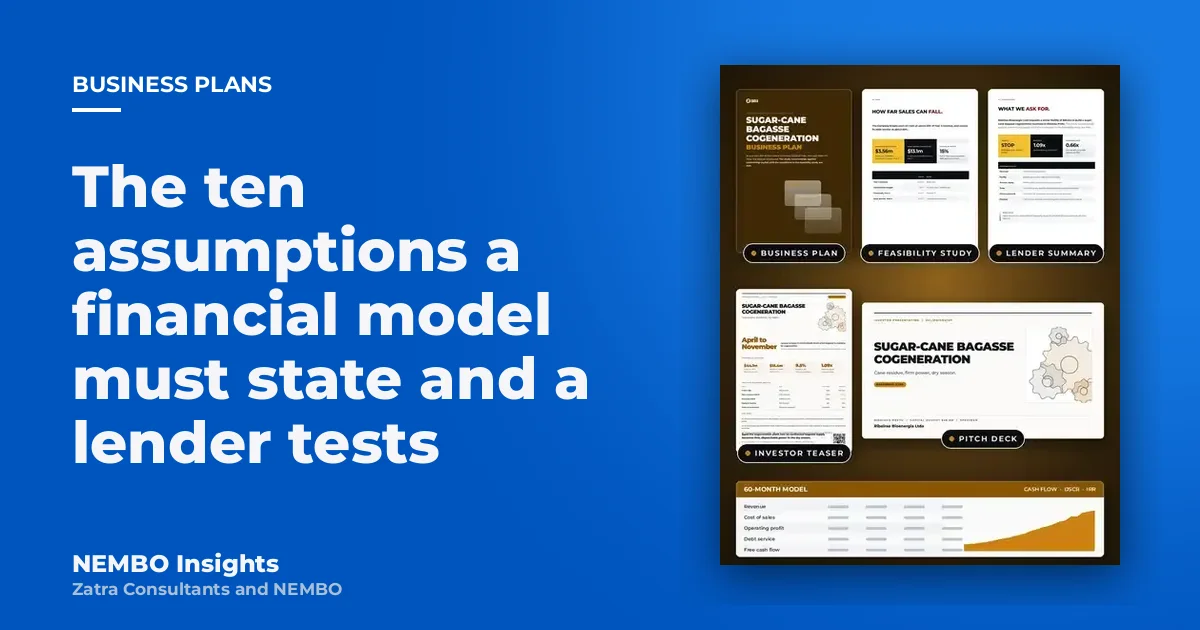
A model states ten assumptions: price, volume, ramp-up, working capital days, capex, depreciation, tax rate, exchange rate, interest and terminal value. A lender then re-runs it with named shocks. In the worked example, a downside lowers the weakest debt service cover from 1.62 to 1.05.
A lender reading a financial model does not begin with the profit line. The reader looks for the assumptions behind it, because every output of a 60-month model is a consequence of ten inputs. A model that states them once, with a source or a test beside each, can be challenged line by line. A model that buries them is challenged as a whole and usually returned.
Which ten assumptions must a financial model state?
A model states price, volume, ramp-up, working capital days, capex, depreciation, tax rate, exchange rate, interest and terminal value. Each carries a unit, a start month and a basis. The table sets out what is stated and the published reference a reader tests it against.
| Assumption | What the model states | Reference or test |
|---|---|---|
| 1 Price | TZS per unit, VAT exclusive | VAT is 18 percent 1 |
| 2 Volume | Units a month at maturity | Contracts, orders, sales records |
| 3 Ramp-up | Months from start to full volume | Start dated after the approvals |
| 4 Working capital days | Receivable, inventory and payable days | IAS 2 cost formula and net realisable value 5 |
| 5 Capex | Amount and month of each item | Supplier quotations |
| 6 Depreciation | Method, life, residual value | IAS 16 paragraphs 50 and 51 4 |
| 7 Tax rate | Corporate rate, loss treatment | 30 percent resident rate 1 |
| 8 Exchange rate | TZS per USD on imported cost | Bank of Tanzania rates 3 |
| 9 Interest | Rate, grace period, tenor | Central Bank Rate 6.25 percent 2 |
| 10 Terminal value | Method applied at month 60 | Book value or a stated multiple |
What do the published rates say about tax, interest and exchange?
The published figures give a model its fixed points. The Tanzania Revenue Authority lists corporate income tax at 30 percent for resident and non-resident corporations, VAT at 18 percent, withholding tax on interest at 10 percent, and a charge of 0.5 percent of turnover for resident corporations with unrelieved losses for three consecutive years, excluding agriculture, health and education 1.
The Bank of Tanzania raised the Central Bank Rate from 5.75 percent to 6.25 percent at its Monetary Policy Committee meeting of 2 July 2026, with a stated inflation target of 3 to 5 percent 2. Its January 2026 report records overall lending rates of 15 to 16 percent in 2025, negotiated prime rates of about 12 percent, and a shilling that traded between 2,432.77 and 2,471.73 per US dollar in the fourth quarter of 2025 3. IAS 16 requires the depreciable amount to be allocated over the useful life, and residual value and useful life to be reviewed at least at each financial year-end 4. IAS 2 carries inventory at the lower of cost and net realisable value 5.
How does a lender stress-test the assumptions?
A lender re-runs the model with named shocks and reads debt service cover in every year. A World Bank Group guide describes the pattern: financial ratios are tested with construction costs 20 percent higher or revenues 10 percent lower, and cover is the cash flow available to meet periodic interest and principal 6. The NMB and CRDB SME pages list steady cash flow as an eligibility point and publish no cover ratio, so the lender's own minimum is asked for in writing 78.
- Volume: a fixed percentage below the base.
- Ramp-up: the start delayed by a stated number of months.
- Working capital: receivable days extended.
- Exchange rate: the shilling weaker on imported cost.
Worked example: a 60-month model with a downside case
Source: NEMBO computation from the stated assumptions; rates from Bank of Tanzania, Monetary Policy Report, January 2026.
Note: illustrative, IFRS Accounting Standards basis, VAT exclusive, year 1 working capital funded by equity. Nothing here is an offer or a guarantee.
Which assumptions draw the first challenge?
Ramp-up, working capital and the exchange rate draw the first challenge, because each moves cover before profit moves. In the example, the year 1 working capital build of TZS 265.0 million equals 44 percent of capex of TZS 600 million. A reader who sees that figure beside the equity commitment knows whether the funding plan holds.
What the NEMBO desk prepares
The NEMBO plan desk, authored and checked by Zatra Consultants Limited, prepares the 60-month Excel model with live formulas and a Base, Downside and Upside switch in TZS or USD, an assumptions page listing the ten inputs with their basis, and debt service cover in each case. The model sits inside the business plan and the lender summary. Documents are scoped and quoted in writing, and the quote states the delivery date.
A 60-month model that survives the downside
The desk prepares the 60-month model with a Base, Downside and Upside switch, debt service cover in each case, and the assumptions page a lender reads.
Open the plan deskSources and status
Accurate as at 17 October 2026. Every figure below was read at the source named, on the date shown.
- 1Taxes and Duties 2023/2024Tanzania Revenue Authority (TRA), July 2023. Accessed 17 October 2026.
- 2Monetary Policy Committee statement, MPC No. 244Bank of Tanzania, 3 July 2026. Accessed 17 October 2026.
- 3Monetary Policy ReportBank of Tanzania, January 2026. Accessed 17 October 2026.
- 4IAS 16 Property, Plant and EquipmentIFRS Foundation, as revised in 2003. Accessed 17 October 2026.
- 5IAS 2 InventoriesIFRS Foundation, undated. Accessed 17 October 2026.
- 6Key Issues in Developing Project Financed TransactionsWorld Bank Group, ppp.worldbank.org, undated. Accessed 17 October 2026.
- 7SME LoansNMB Bank Plc, undated. Accessed 17 October 2026.
- 8SME Bidii loanCRDB Bank, undated. Accessed 17 October 2026.
Figures to confirm before you act
- The corporate income tax rate and loss rules in force on the model date, with the Tanzania Revenue Authority.
- The exchange rate and Central Bank Rate on the model date, with the Bank of Tanzania.
- The interest rate, grace period and tenor offered, with the lender.
- The minimum debt service cover and the shocks the lender applies, with the lender's credit officer.
- The depreciation lives and inventory cost formula adopted, with the entity's auditor.
This article is general information based on official sources available at the date of publication. It is not legal, tax, valuation or financial advice. Laws and notices change. Verify with the issuing authority or consult Zatra Consultants Limited before acting.
Frequently asked questions
What is the most important assumption in a financial model?
No single input decides the result. Ramp-up, working capital days and the exchange rate move debt service cover first, because they hit cash before profit. A lender tests each by shock, so the model shows the result of each separately and combined.
What corporate tax rate should a Tanzanian model use?
The Tanzania Revenue Authority's Taxes and Duties publication of July 2023 lists 30 percent for resident corporations. It also lists a 0.5 percent of turnover charge for resident corporations with unrelieved losses for three consecutive years. The current rate is confirmed with the Authority.
Which exchange rate should a model apply?
The model states one rate for imported cost and a weaker rate in the downside. The Bank of Tanzania reported a range of 2,432.77 to 2,471.73 shillings per dollar in the fourth quarter of 2025, and a model dated later uses the Bank's current rate.
What interest rate belongs in a loan assumption?
The rate offered by the lender. The pages of NMB and CRDB read for this note publish no figure. The Bank of Tanzania reported overall lending rates of 15 to 16 percent in 2025, which is context for an assumption and not a quotation.
How is terminal value set in a 60-month model?
By a stated method. The example uses book value at month 60, which is cost minus accumulated depreciation under IAS 16. A multiple of earnings is an alternative, and a lender will ask for the multiple's basis.
What debt service cover do lenders require?
Each lender sets its own minimum, and the NMB and CRDB SME pages read publish none. Cover below 1.00 means operating cash does not meet scheduled payments. The model shows the figure in every year and in the downside.
Why does a model need a downside case?
A base case shows what management expects. A downside shows whether loan payments survive a weaker year. In the example, cover falls from 1.62 to 1.05 and year 1 funding need rises from TZS 221.0 million to TZS 462.3 million.