On this page
What does the going concern assessment under IAS 1 require?
IAS 1 requires management to assess going concern by looking at least twelve months from the end of the reporting period, and to disclose material uncertainties [1]. Evidence is forecasts, facility terms, covenant tests and lender waivers. For periods beginning on or after 15 December 2026, auditors look twelve months from approval of the statements [4].
A company can hold cash and still breach a covenant. When the breach falls inside the next twelve months, the going concern question moves from the auditor's checklist to the lender's desk. A finance lead who prepares the assessment as a paragraph, and not as a dated file, meets that question late.
IAS 1 sets the assessment. This note sets out what it requires, the period each party looks at, the evidence that supports the conclusion, and how a lender reads it, with a covenant breach computed for one fictional company.
What does IAS 1 require on going concern?
IAS 1 also deals with going concern issues 2, and it applies to entities on full IFRS, which Technical Pronouncement No. 1 of 2018 assigns to public interest entities and public commercial entities 7. Management assesses the entity's ability to continue as a going concern, looking at least twelve months from the end of the reporting period. The period is a minimum and not a cap, and management takes into account all available information about the future 1. Material uncertainties relating to going concern are disclosed (paragraph 25), and an entity that is not a going concern discloses that fact, the reasons and the basis of preparation 1.
IFRS 18 replaces IAS 1 for annual periods beginning on or after 1 January 2027, and moves some IAS 1 paragraphs to IAS 8 3. The IFRS Foundation's May 2025 republication cites the requirement as paragraph 6L of IAS 8, corresponding to IAS 1 paragraph 26 1.
What period does each party look at?
| Party | Looks forward | Source |
|---|---|---|
| Management under IAS 1 | At least 12 months from the end of the reporting period | IAS 1 paragraph 26 1 |
| Auditor under ISA 570 (Revised 2024) | At least 12 months from the date of approval of the financial statements | IAASB, effective for periods beginning on or after 15 December 2026 4 |
| Audit committee of a listed company | Going concern assumption at quarterly, half-yearly and year-end reviews | CMSA guidelines, section 4.5.3 6 |
The two twelve-month periods start on different dates. For a calendar-year company with statements approved on 15 April 2028, management looks to at least 31 December 2028, and the revised auditor standard looks to at least 15 April 2029, which is 105 days later. The revised standard first applies to periods beginning on or after 15 December 2026, so the year ending 31 December 2027 is the first for a calendar-year company 4.
What evidence supports the assessment?
The IFRS Foundation lists current and expected profitability, the timing of repayment of existing financing facilities and potential replacement financing as factors management considers 1. Where significant judgement is involved, the entity also considers the feasibility and effectiveness of management's plans, and discloses the judgement even where it finds no material uncertainty (paragraph 122) 1.
- A 12-month cash forecast with a downside case, and the 13-week forecast for the first quarter.
- Facility letters: amounts, maturity dates and covenant definitions.
- A covenant test in the base and downside cases, dated to each test date.
- Written waivers, resets or replacement financing from the lender.
- Management actions with an amount, an owner and a date.
How does a lender read the assessment?
A lender reads headroom to each covenant in the downside case, then liquidity against maturities, then the status of any waiver. TFRS 1 expects the annual report to discuss current and prospective liquidity (paragraph 37) and covenants in financing contracts (paragraph 37.3) 5. The text as read does not contain the phrase going concern, so the conclusion sits in the financial statements and the report carries the liquidity discussion beside it 5.
Source: worked example computed from the stated operating cash flow and debt service of TZS 330 million.
Note: illustrative figures on an IFRS basis, IAS 1 paragraphs 25 and 26. The covenant is assumed. Nothing here is an offer, a credit decision or a guarantee of any lender's or auditor's view.
What to do now
- Set the horizon Fix the end date: twelve months from the reporting date at the least.
- Collect the facilities List amounts, maturities and covenant definitions from the signed letters.
- Run the downside Compute cover and cash at each test date.
- Size the gap Compute the operating cash needed to clear each covenant.
- Document the plan Record each action with an amount, owner and date, and obtain the lender's written position.
- Disclose Agree with the auditor whether the conclusion is a judgement or a material uncertainty.
What the NEMBO desk prepares
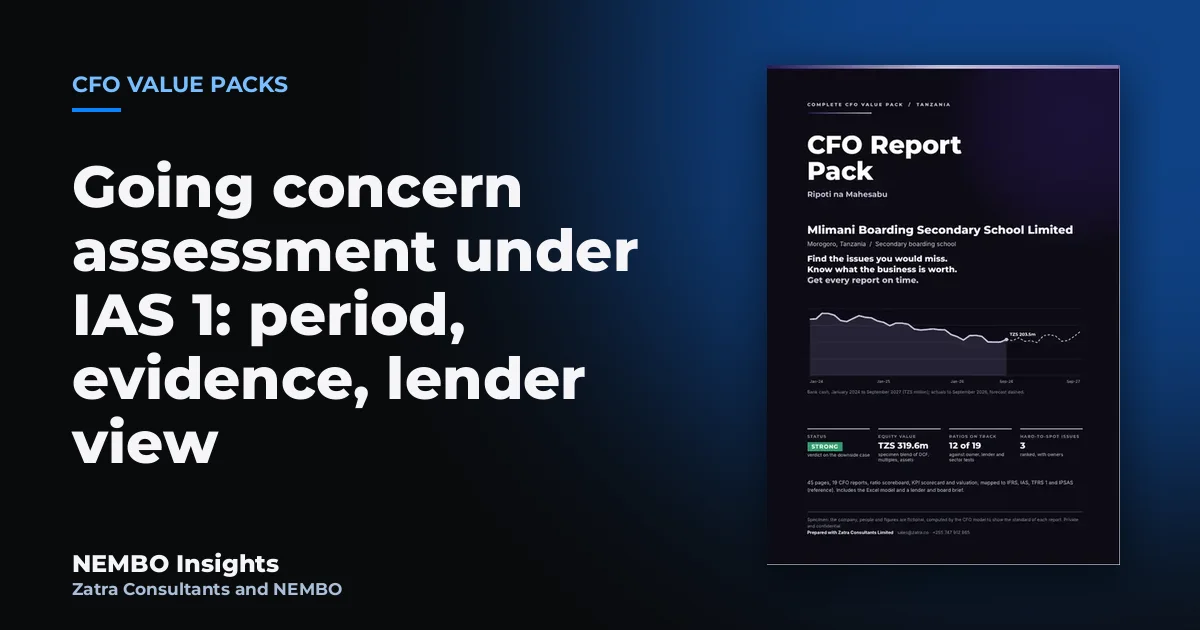
Zatra Consultants Limited authors and checks the figures, and NEMBO designs and delivers. The Client shares the ledger or trial balance, bank statements and debt schedules. The CFO pack returns with the reporting basis named, a verdict from cash, debt service cover and net margin in the downside case, a cash runway tracker, a Lender and Board Brief and an Excel working file with live formulas 8. Fees are quoted in writing, and the written quote states the date for the scope agreed.
The directors and the auditor conclude on going concern. The pack is an illustrative management estimate, not an audit, an assurance report or a valuation, and it decides no lender's view.
A going concern file a lender can test
The desk prepares the CFO pack with a downside case, debt service cover, a cash runway tracker and an Excel working file tied to the ledger.
Open the CFO deskSources and status
Accurate as at 17 October 2026. Every figure below was read at the source named, on the date shown.
- 1Going concern, a focus on disclosureIFRS Foundation, Republished May 2025. Accessed 17 October 2026.
- 2IAS 1 Presentation of Financial StatementsIFRS Foundation, undated. Accessed 17 October 2026.
- 3IFRS 18 Presentation and Disclosure in Financial StatementsIFRS Foundation, April 2024. Accessed 17 October 2026.
- 4IAASB strengthens auditor responsibilities on going concern through revised standardInternational Auditing and Assurance Standards Board, 9 April 2025. Accessed 17 October 2026.
- 5Tanzania Financial Reporting Standard No. 1: The Report by Those Charged with GovernanceNational Board of Accountants and Auditors, Approved 22 June 2020. Accessed 17 October 2026.
- 6Guidelines on Corporate Governance Practices by Public Listed Companies in TanzaniaCapital Markets and Securities Authority, text hosted by RegAlert, undated. Accessed 17 October 2026.
- 7Technical Pronouncement No. 1 of 2018National Board of Accountants and Auditors, Approved 26 September 2018. Accessed 17 October 2026.
- 8CFO Value Pack: financial reports for Tanzanian businessesNEMBO, undated. Accessed 17 October 2026.
Figures to confirm before you act
- The reporting framework of the entity, with its accountant against Technical Pronouncement No. 1 of 2018.
- Where the going concern paragraphs sit for periods to which IFRS 18 applies, with the IFRS Foundation.
- The covenant definitions, test dates and any waiver, with the lender.
- The auditing standard applicable to the audit period, with the entity's auditor.
- For a listed company, the current text of the governance guidelines, with the Capital Markets and Securities Authority.
This article is general information based on official sources available at the date of publication. It is not legal, tax, valuation or financial advice. Laws and notices change. Verify with the issuing authority or consult Zatra Consultants Limited before acting.
Frequently asked questions
How far ahead must management look for going concern?
At least twelve months from the end of the reporting period under IAS 1. The period is a minimum and not a cap, and management takes into account all available information about the future, including profitability, financing repayments and replacement financing.
When is a material uncertainty disclosed?
IAS 1 requires an entity to disclose material uncertainties relating to its ability to continue as a going concern. Where the entity is not a going concern, it discloses that fact, the reasons and the basis on which the statements were prepared.
Does a covenant breach mean the entity is not a going concern?
No. A breach is a fact that management weighs with the lender's written position, the cash available and the actions planned. The conclusion depends on that evidence, and the directors and the auditor decide it. In the example, cash meets the instalments.
What changes in the auditor's period under ISA 570?
The revised ISA 570 extends the auditor's evaluation period to at least twelve months from the date of approval of the financial statements. It is effective for audits of periods beginning on or after 15 December 2026.
What evidence does a lender expect?
A lender expects a downside cash forecast, covenant tests at each test date, facility maturities and written confirmation of any waiver. A file that sizes the gap and names the actions answers the question before it is asked.
Does a small company apply IAS 1?
IAS 1 applies to entities on full IFRS. Technical Pronouncement No. 1 of 2018 assigns other tiers to smaller commercial entities. The accountant confirms the tier and the equivalent going concern requirement before the file is prepared.
Does the pack decide the going concern conclusion?
No. Directors conclude with the auditor. The NEMBO pack tests cash, debt service cover and margin in the downside case and sets out the evidence, as an illustrative management estimate that is not an audit or an assurance report.